Yin Yang Symbol Meaning: The True Balance of Opposites
May 02, 2026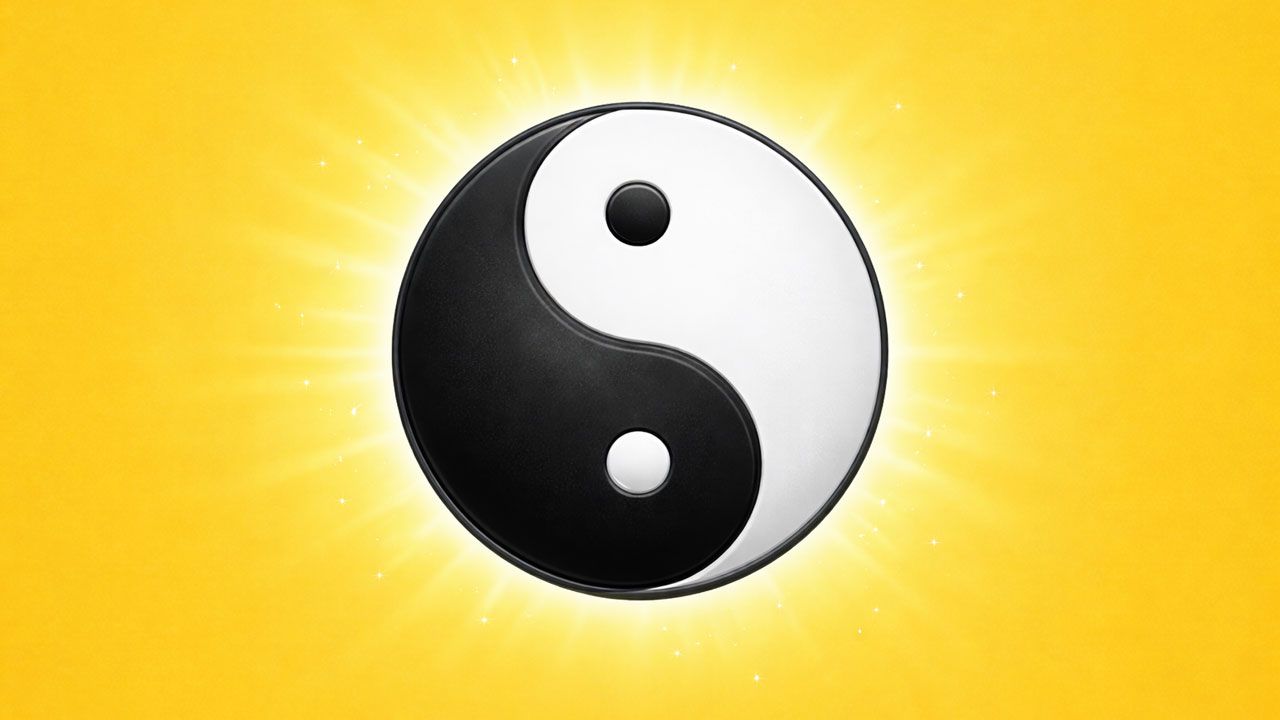
There is a saying that a picture is worth a thousand words. This is so true. And in the case of sacred geometry, each symbol is packed with esoteric significance, offering a powerful transmission in service of spiritual awakening.
The ancient Yin Yang Symbol from China is a supreme example of a power packed sacred geometry transmission, representing a dynamic and living flow of duality as a basis for all of creation.
The black area represents Yin, aligned with the Feminine principle of creation.
The white area represents Yang, aligned with the Masculine principle of creation.
In life, there are two possible spiritual paths. One is aligned with the feminine and carries the qualities of love and devotion.
The other is aligned with the masculine and carries the qualities of meditation and witnessing.
Yin Yang Symbol Meaning
The yin yang symbol is a precise visual representation of reality as understood within ancient Chinese cosmology and ancient Chinese philosophy. Within this symbol, the universe is seen as an ever-evolving field of duality, movement, and intelligent order.
At first glance, we see a circle divided into a flowing black and white form with a dark swirl and its luminous white counterpart. This symbol shows us that all apparent opposites are expressions of a deeper unity and the supreme ultimate (Taiji), from which yin and yang arise.
The black region represents yin, while the white region represents yang. The curved line between them shows continuous motion, a process of cyclical change that governs all physical manifestations in the natural world. In classical Chinese thought, yin refers to the shady side of a mountain, which is inward, cool, receptive, and hidden.
Yang, by contrast, refers to the sunny side, which is outward, warm, active, and visible. These definitions are rooted in direct observation of nature. The inclusion of the small dots, with each containing the opposite color, reveals the essential truth, that within yin, there is always the seed of yang, and within yang, the seed of yin.
This illustrates the complementary nature of existence, where each force carries the potential to transform into its apparent opposite. This principle is deeply embedded in the I Ching, one of the oldest texts of chinese philosophy, and later refined through the teachings of Lao Tzu (Laozi) in the Tao Te Ching, a foundational text of the Tao. Here, reality is a dynamic interplay of yin and yang unfolding across the universe.
From this perspective, the yin yang symbol is instructional. It shows how life, the earth, and the world itself are sustained through the constant movement and rebalancing of these complementary forces.
Yin Yang Balance Sustains All Of Creation
When we move from philosophy into lived experience, the yin yang symbol becomes directly applicable to the human body and energetic awareness.
In traditional Chinese medicine and classical chinese medicine, the body is understood as a system governed by yin and yang in dynamic balance. Health is the harmonious relationship between these two forces across organs, systems, and emotional states.
For example, organs such as the Kidneys, Bladder Lungs and Large Intestine are often associated with yin, storing essence and regulating internal processes, while the organs of Liver, Gall Bladder, Stomach, Spleen and Pancreas are Yang. When this balance is disturbed, illness arises as a reflection of imbalance within the whole system.
In daily life, periods of activity (yang) must be balanced with rest (yin). Expression must be balanced with reflection. Giving must be balanced with receiving. When one force dominates excessively, the system compensates, illustrating again the law that when one expands, the other decreases, only to return in time.
This is why practices such as tai chi and internal martial arts are considered profound applications of the yin yang philosophy. Rather than relying on brute force, they cultivate sensitivity to flow and the intelligent redirection of energy. A soft movement (yin) can neutralise a strong attack (yang), demonstrating that true power lies in understanding the complementary forces at play.
In more intimate dimensions of life, this same principle applies. In erotic interactions, the most fulfilling experiences arise when partners move in awareness of yin and yang, allowing waves of giving and receiving, activity and surrender, to unfold naturally.
The Yin Yang Symbol as a Living Philosophy of Balance and Harmony
At its deepest level, the yin yang symbol expresses the essence of the Tao, the underlying intelligence of the universe that moves through all things.
In the Tao Te Ching, Lao Tzu describes reality as a process that cannot be forced, only aligned with. This principle is known as wu wei, and involves action without strain and effort without resistance.
Yin Yang draws focus onto internal harmony and the integration of polarities within consciousness itself.
We see this reflected in the structure of the symbol through the continuous flow, the absence of rigid boundaries, and the perfect equilibrium of form. It reminds us that yin and yang are necessary partners and are expressions of a deeper unity.
Historically, these insights developed during periods such as the Zhou Dynasty, where systems like the I Ching encoded the patterns of cyclical change into hexagrams, offering a sophisticated model of reality based on transformation rather than permanence.
The yin yang symbol is therefore one of the most complete philosophical diagrams ever created. It integrates chinese philosophy, observation of nature, and direct human experience into a single, elegant form.
Read: What is Tantra and Tao? Balancing Energy, Pleasure, and Spirit
Tantra Embraces both Yin and Yang
Tantra embraces opposite polarities, equally honouring both yin and yang as essential expressions of life. Within this philosophy, nothing is rejected and everything is included, transformed, and brought into balance. This is because Tantra recognises a profound truth, that wherever opposites meet and consciously merge, a higher state of awareness becomes available.
Tantra understands that yin and yang are complementary forces, each incomplete on their own, yet perfectly whole together. It is through their union that we experience deeper states of connection and ultimately, truth.
If you are moving along the path of yang, through meditation, awareness, and witnessing, there comes a point where effort dissolves, and you naturally soften into yin. The mind becomes quiet, and what remains is openness, receptivity, and love. The flowering of yang becomes devotion.
Likewise, if you are moving along the path of yin through love, surrender, and feeling, there comes a moment where clarity arises. Awareness sharpens, and you find yourself rooted in stillness and witnessing. The flowering of yin becomes yang.
The path of one always leads into the other. There is no fixed endpoint, only a continuous unfolding within the duality of existence.
In this sense, the journey is about being total in your experience. When you fully embody one pole, the transformation into its opposite happens naturally, as part of the inherent intelligence of the universe.
Tantra teaches that this movement between yin and yang is a process that flows through the human body, relationships, and all aspects of life. It is the same intelligence that moves through nature and through consciousness itself.
It is truly remarkable that such a vast and subtle understanding of balance and unity could be expressed through such a simple symbol thousands of years ago.
Inspirational Quotes about Ying Yang
- “He who knows that enough is enough will always have enough.” - Lao Tzu
- “Nature does not hurry, yet everything is accomplished.” - Lao Tzu
- “Harmony is the blending of yin and yang.” - Traditional Chinese proverb
- “Knowing others is intelligence; knowing yourself is true wisdom. Mastering others is strength; mastering yourself is true power.” - Lao Tzu
- “The Yin absorbs the Yang; the Yang absorbs the Yin—this secret is so simple it goes unnoticed and undetected. Like all of nature it must fuse and intermingle with its opposite to achieve growth and potential. As a tree cannot exist without both sun and water, humans cannot exist without sexual energy. Immortality can only be achieved through the disciplined use of sexual energy.” - The White Tigress Manual (Secrets of the female Taoist Masters)
- “If we never experience the chill of a dark winter, it is very unlikely that we will ever cherish the warmth of a bright summer’s day. Nothing stimulates our appetite for the simple joys of life more than the starvation caused by sadness or desperation. In order to complete our amazing life journey successfully, it is vital that we turn each and every dark tear into a pearl of wisdom, and find the blessing in every curse.” - Anthon St. Maarten, Divine Living: The Essential Guide To Your True Destiny
- “The Pentacle - The ancients envisioned their world in two halves - masculine and feminine. Their gods and goddesses worked to keep a balance of power. Yin and Yang. When male and female were balanced, there was harmony in the world. When they were unbalanced there was chaos.” - Dan Brown, The Da Vinci Code
- “All in the eye of the beholder - Some of the most destructive forces in the world (Fire & Water), can also have the power of beauty.” - Martin R. Lemieux
- “When we practice sacred sexuality we are working with cosmologically rooted principles, balancing the heavenly yang (male energy) of the universe with the all-knowing, life-giving yin (feminine energy) of the earth within ourselves.” - John Maxwell Taylor, Eros Ascending: The Life-Transforming Power of Sacred Sexuality
- “Yes and no is yin and yang in life And you will encounter this every day of your life, No matter who you are, what your status is in life, No matter what your aspirations and dreams are in life. - Kenan Hudaverdi