Amrita Nadi: The Inner Sun & the Axis of Consciousness
Apr 08, 2026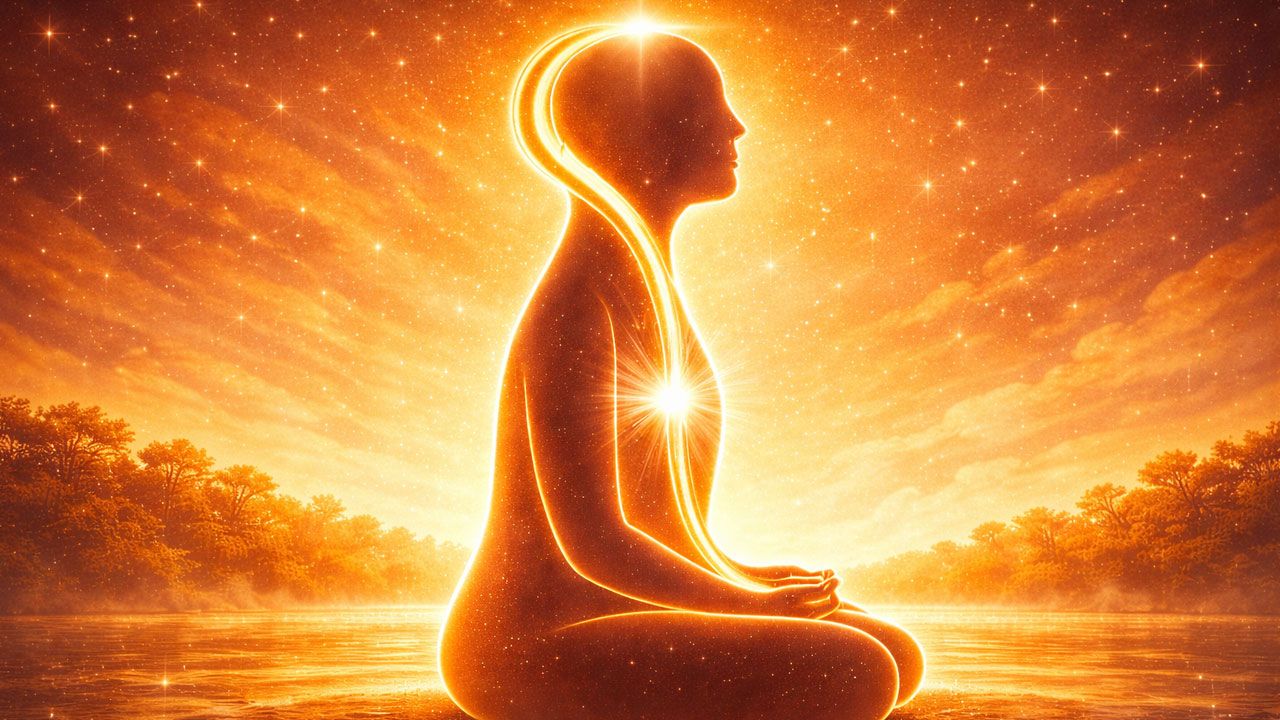
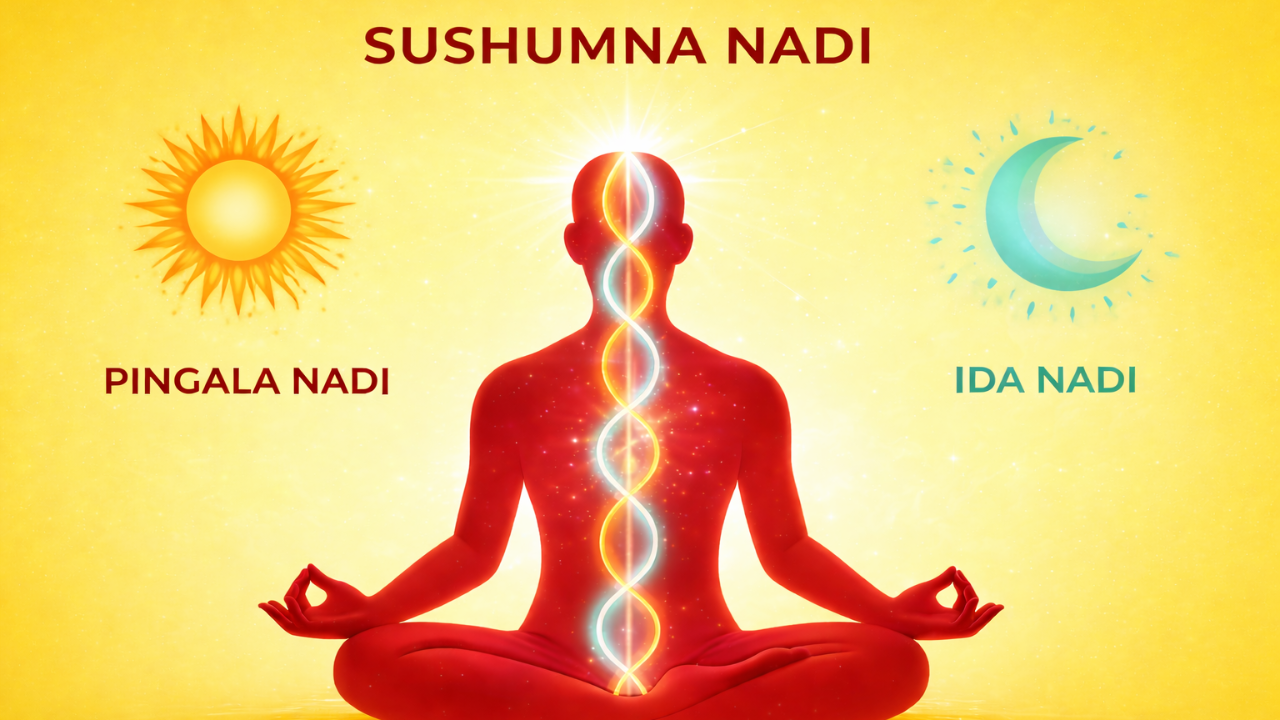
Amrita Nadi, often spoken of interchangeably as Atma Nadi, is described in certain non-dual and yogic traditions as the subtle channel of the Self and the living axis of consciousness that extends from the spiritual Heart on the right side of the chest to the crown.
The Heart on the Right is located a few centimeters to the right of the centre chest, and this is the anatomical location referenced in these teachings. It refers to a direct current of awareness through which the Self knows itself as Self.
Amrita Nadi is known as the channel of bliss and immortality, the seat of Source Consciousness. “Atma” means the true Self. “Amrita” means nectar, the deathless.
Amrita Nadi is often viewed as a transcendental channel beyond the standard 72,000 nadis that circulate prana. When we use these terms, we are pointing toward the direct recognition of one’s native reality. In this sense, Atma Nadi and Amrita Nadi are synonymous and two names for the same truth.
Amrita Nadi is the form of consciousness itself. It is the perfect realisation.
The Inner Sun And Core Concepts
The Inner Sun is a metaphor used to describe the luminous centre of awareness experienced in the spiritual Heart, also known as Hridaya. This does not refer to the physical organ, but the subtle Heart located on the right side of the chest in certain non-dual traditions. It refers to the radiant, self-existing light of consciousness that shines prior to thought, emotion, or identity. Just as the outer sun illuminates the world, the Inner Sun illuminates experience itself.
In these teachings, attention is gently returned to the right-side spiritual Heart as the seat of the Self. This location is described as the source-point from which awareness arises and into which it subsides.
If the Inner Sun is the radiant source of awareness in the spiritual Heart, then Amrita Nadi is the subtle axis through which that radiance is recognised and stabilised. Amrita Nadi is described as extending from the right-side Heart to the crown as the vertical axis of realisation. The Heart is the source. The Nadi is the subtle pathway of recognition.
When awareness rests in the Inner Sun, in the Heart, and ceases to move outward into identification, the sense of self may feel as though it opens upward and becomes unbounded. That upward openness is what some teachings describe as the activation or revelation of Amrita Nadi. It is consciousness no longer contracted.
The Inner Sun is the luminous source. Amrita Nadi is the axis of that luminosity. The metaphor of the sun helps articulate the knowing that consciousness shines by its own light and is not dependent on anything outside itself.
The Nature of Consciousness
Consciousness is the ultimate reality that underlies everything. It's the source where every single experience, sensation, and thought springs from, including that sense of being a separate self. In spiritual traditions, this is the living, breathing presence that's animating your body, the world around you, and all of life right now.
The true seat of Consciousness is said to be a subtle point on your right side. This is where you'll find Amrita Nadi, the secret pathway where your I-sense springs up and where the light of your Inner Sun shines brightest.
You don't need to achieve the perfect form of Reality through effort or striving. Instead, it's your natural state of boundless Consciousness that shines through when you transcend that I-sense. In this state, perfect knowledge and unqualified enjoyment arise all on their own.
Your physical body, the world, everything around you, it's all manifestations of source Consciousness. They're expressions of the same light shining from your Heart on the Right, through your crown chakra, and into all existence.
Roots of Amrita Nadi
Teachings about the spiritual Heart as the seat of the Self have deep roots in the Upanishads, particularly texts such as the Chandogya and Brihadaranyaka Upanishad, which describe the Heart (hridaya) as the dwelling place of Atman. However, these early references do not anatomically specify the right side of the chest.
The explicit teaching that the Self is realised in the right-side spiritual Heart becomes most clearly associated with Ramana Maharshi (1879–1950). Ramana stated that while the physical heart lies on the left, the spiritual Heart, the source of the “I”-sense, is located on the right side of the chest.
According to later accounts from close devotees, he explained that when the mind sinks into the Heart through self-inquiry and meditation, the current of consciousness rises through this Nadi to the sahasrara (crown), culminating in stable realisation.
Sahaj Samadhi and the Yoga of Amrita Nadi
Sahaj Samadhi means natural, effortless awareness. It means being fully conscious while living your normal life but without being tightly identified with your thoughts.
In this teaching, the main problem is something called self-contraction. Self-contraction is the habit of shrinking awareness into a small, tight sense of “me.” Instead of experiencing ourselves as open and present, we feel like a thinker inside the head. The simple sense of “I am” becomes “I am this person with these problems.” That narrowing creates tension and the constant feeling that something is wrong. Desire is a key obstacle here, as it binds attention to the ego and identification, making it harder to realize the true Self.
The teaching about Amrita Nadi says that this contraction hides something deeper. At the center of your chest is the source of the I-sense. When attention relaxes out of the head and settles back into the Heart, the tight identity begins to soften. The Heart on the Right is where God resides, the place of the Self, and where Consciousness shines through.
Amrita Nadi is the name given to what becomes obvious when that softening happens. It is the feeling that awareness is no longer trapped in the head. Instead, it feels open, steady, and sometimes as if it extends beyond the body.
Self-Contraction & the “Primordial Error”

Some teachings say the root problem of ego is not sin or moral failure. It is a mistake, a misunderstanding, known as the “primordial error,” which simply means misidentifying who we are.
At our core, we are open awareness. But instead of experiencing ourselves as open and spacious, our attention narrows. It contracts into a small, focused point, usually felt in the head. Instead of being the whole field of awareness, we feel like a thinker inside the brain.
That narrowing is what creates ego. In this moment of contraction, 'I-ness arises,' the sense of ego and self-identity emerges from inner blockages or spiritual distortions. The basic sense of “I am” is natural and simple. But when attention contracts, that “I” becomes tight and personal. It turns into “me” and my story, my problems, my fears. The ego is not a separate thing that appears. It is just awareness squeezed into a small identity.
When awareness shrinks like this, it creates tension and there is often a background feeling that something is wrong or missing. The mind starts working constantly by analyzing, fixing, worrying. It is trying to resolve the discomfort of being compressed.
You can think of it like an eclipse. The sun (your deeper awareness) is still shining, but something blocks your view of it. The contraction pulls identity up into the head and away from the deeper center of the chest, called the true Heart. Instead of resting as open presence, you feel like a small self managing life. Over time, this feels normal. You forget that awareness was ever open. You assume the tight, thinking self is who you are.
Sat–Chit–Ananda and the Axis of the Heart
In Advaita Vedanta, the essential nature of the Self is described as Sat–Chit–Ananda — Being, Consciousness, Bliss. This formulation, rooted in texts such as the Chandogya Upanishad and Brihadaranyaka Upanishad, asserts that reality itself is self-existing (Sat), self-luminous (Chit), and intrinsically whole (Ananda). They describe the structure of what you fundamentally are prior to the seemingly self contracted identity that develops through conditioning.
Sat refers to pure Being and the undeniable fact of existence before it becomes personal. Before the thought “I am this body” or “I am this history,” there is simple presence. In the teaching of the right-side spiritual Heart, not the left heart and not merely the heart chakra of yogic mapping, this Being is intuited as a subtle but exact locus in the chest. It is described as the place where the I-sense arises. When attention is inwardly focused and begins to trace attention back to its source, what is discovered is that the basic sense “I am” precedes all narratives. That discovery is nearly the same process described in self-inquiry traditions: the I-sense arises, and rather than following it outward into identification, it is allowed to return to its origin.
Chit refers to consciousness as self-revealing. Awareness does not need another light to illuminate it; it shines by its own nature. Under normal circumstances, attention is outwardly focused, absorbed in objects, problems, relationship, and survival. This outward orientation becomes an automated process. Over time, identity compresses into what feels like a thinker inside the head. Thus a sense of separation forms. The boundless Self appears eclipsed, even though the source shines continuously. All the suffering experienced in real life arises from this contraction, not from reality itself but from misidentification with a narrowed point of view.
Ananda, often translated as bliss, refers to structural completeness and the absence of lack. When attention relaxes out of contraction and settles into its source in the spiritual Heart, even relaxation can reveal that nothing is missing. Bliss shines as unobstructed wholeness. The healing process in this context is the gradual dissolution of the contraction that generates all the suffering. As contraction softens, full consciousness becomes obvious.
Within this framework, Amrita Nadi describes the stabilising axis of this recognition.