The Soham Mantra & the Wisdom of Sanskrit Mantras
Apr 22, 2026
The Soham mantra is a Sanskrit mantra meaning "I am That," with So meaning "I am," Hum meaning "That," referring to the universal consciousness that underlies all of existence.
It comes from the ancient yogic tradition and is considered one of the most fundamental mantras in Hindu philosophy, appearing in texts as old as the Upanishads.
Unlike mantras that are assigned by a teacher or chanted aloud in ritual, Soham is described as the mantra that chants itself, because the natural sound of the breath already produces it.
Every inhale carries the sound So. Every exhale carries the sound Hum. Which means you have been practicing it since the moment you were born.
What Is the Soham Mantra? A Universal Mantra Hidden in Every Breath
Soham is a direct statement of identity between the individual self and universal reality. Every incoming breath naturally carries the subtle sound So. Every outgoing breath carries Hum.
This is why Soham is known as an ajapa japa mantra, a mantra that repeats itself without effort. It is not something you need to impose onto the breath or remember to practice. It is already happening, continuously, from the moment you are born.
The practice is simply to become aware of it. The Soham mantra is the breath’s own prayer, and a reminder that lives in every inhale and exhale you will ever take. This deceptively simple mantra works on transforming the feeling of being cut off and acting as an independent identity moving through a world that feels unpredictable and overwhelming.
With every breath, it points back to an understanding that you are not separate from life, you are an expression of it. When you breathe with Soham, you are shifting identification from the small, thinking self to the wider field of awareness in which that self exists.
Soham and the Hamsa Mantra
Soham comes from one of the central teachings of yogic and Upanishadic philosophy that the individual self (Atman) is not separate from ultimate reality (Brahman).
The mantra expresses this directly:
Inhale: So
Exhale: Hum
“I am That.”
Closely related to Soham is another mantra, the Hamsa mantra. Hamsa is actually the same mantra, heard in reverse:
Exhale: Ham
Inhale: Sa
If Soham is So–Hum, Hamsa is Ham–Sa.
In Sanskrit, hamsa means “swan.” In yogic traditions, the swan is a powerful symbol of discernment, said to have the mythical ability to separate milk from water, representing the capacity to distinguish what is real from what is temporary or illusory.
But in the context of mantra, Hamsa points to a different way of understanding the same breath.
Soham begins with the individual: I am That.
It is the movement of recognition and awareness returning to its source, dissolving identification with the limited self.
Hamsa begins with the universal: That am I.
It is the movement of expression, the same awareness taking form, expressing itself as the many. So rather than being two separate mantras, Soham and Hamsa are two ways of describing the same process from opposite directions.
In some traditions, this is described as two movements of divine consciousness:
Soham - the return (inward, toward unity)
Hamsa - the expression (outward, into form)
So what seems like two mantras is really one continuous rhythm with the pulse between the infinite and the individual, the formless and form.
Soham is the recognition, like the wave realizing it is the ocean.
Hamsa is the expression, like the ocean appearing as the wave.
So in a sense, the true meaning of Soham is; that which is, was and will always be, the eternal reality; “I am that” or, Hamsa, “that am I.”
The Science Behind the Soham Mantra
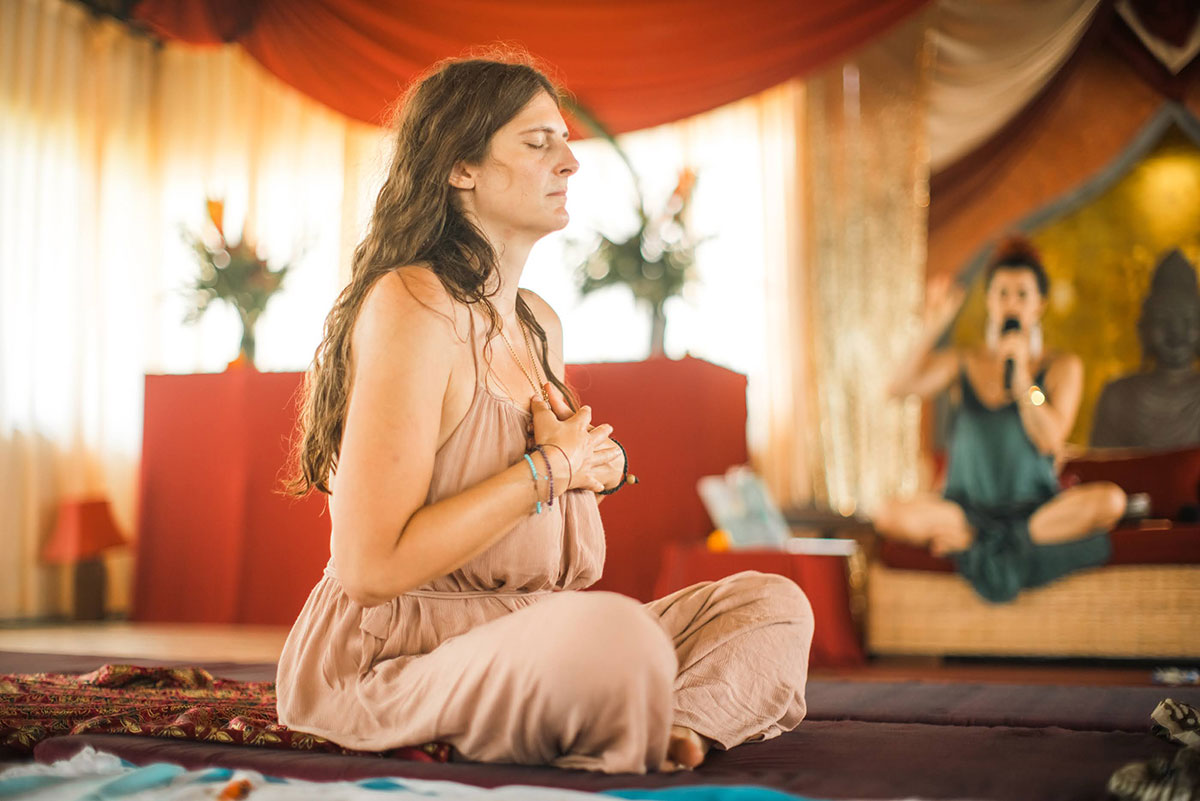
Soham works by regulating two things at once, namely your breathing and your attention.
When you follow the natural rhythm of the mantra, inhale (So), exhale (Hum), the breath begins to slow down and stabilise. Without forcing anything, the exhale often becomes slightly longer than the inhale. This shift is important, because the exhale is directly linked to activation of the parasympathetic nervous system, the part of the body responsible for calming you down.
As the exhale lengthens and softens, heart rate begins to slow, muscle tension decreases, and the body receives a clear signal that it is safe. The “Hum” on the exhale reinforces this pattern. If the sound is audible, the subtle vibration in the chest and throat can stimulate the vagus nerve, which plays a central role in regulating stress and emotional response. Even when silent, the shape of the breath itself supports this calming effect.
At the same time, Soham works on the level of the mind. The brain has a network known as the Default Mode Network, which is most active when attention is unfocused, when the mind is wandering, replaying the past, or anticipating the future. This is also the state most closely associated with anxiety and overthinking.
Soham gives that mental activity a clear structure. By placing attention on the breath and pairing it with the internal sound you redirect attention away from those loops and into a steady, repetitive anchor.
Each time the mind drifts and you bring it back, you are strengthening the brain’s ability to regulate attention. Over time, this reduces the tendency to get pulled into repetitive thought patterns and increases your ability to stay present, even under stress.
Sanskrit Words & the Philosophy of Pure Awareness Rooted in Ultimate Reality

The Soham mantra points to a deep understanding that the individual is not separate from the whole.
This idea is stated clearly in an older Sanskrit teaching from the Brihadaranyaka Upanishad, known as the Purnamadah Purnamidam mantra:
Om Purnamadah Purnamidam
Purnat Purnamudachyate
Purnasya Purnamadaya
Purnamevavashishyate
Om Shanti Shanti Shanti
The key word is purna, which means “whole” or “complete.” The meaning of the chant is the source of everything is whole. What exists in the world is also whole. What comes from the whole does not become separate from it. And taking from the whole does not reduce it.
This is the foundation of Advaita, or non-duality. Non-duality means there is no real separation between the individual and the whole. What we experience as separate things are different expressions of the same underlying reality.
This is exactly what Soham expresses. “I am That” means the same “whole” described in this chant is what you are, not something outside of you.
The sense of separation comes from perception, not from reality itself. If everything is part of the same whole, then actions are not isolated. What you do affects the same system you exist within.
Lokah Samastah Sukhino Bhavantu: A Radiant Prayer For The Happiness Of All Beings
Up to this point, the focus has been inward and understanding the nature of the self through Soham, Hamsa and Purna. The Lokah Samastah Sukhino Bhavantu mantra shifts the focus outward.
This is a Sanskrit prayer traditionally used in yoga and meditation practices. It is not describing reality like Soham does, it is expressing an intention. Specifically, it is an intention about how we relate to other beings.
“May all beings everywhere be happy and free, and may the thoughts, words, and actions of my own life contribute in some way to that happiness and to that freedom for all.”
The second half of the prayer places responsibility on the individual. It links your inner state to your outward behaviour.
To understand this more clearly, it helps to look at the structure of the mantra:
It begins with Lokah, pointing to all worlds and dimensions of life.
Samastah brings in everyone within them, every being, without exception.
Sukhino expresses the quality of that life: ease, happiness, and freedom.
Bhav anchors it as a state of existence, not just a wish.
And Antu seals it as an intention, a commitment to that reality.
Together, it forms a complete statement that all beings, in all realms, exist in a state of wellbeing and freedom. That last word, Antu, turns the phrase into a commitment. It implies participation and that this outcome is not separate from your actions.
So when you repeat this mantra, you are not just wishing for a better world. You are aligning your own behaviour with that outcome. It connects directly back to the philosophy behind Soham.
To offer such a blessing to the world implies that you yourself are living in alignment with the divine on all levels of being.
There is no separation between you and others. Their wellbeing is your own wellbeing and visa versa.
By contemplating the insightful and powerful intention behind the formulation of Sacred Mantras I feel humbled and in awe. This legacy of compassionate awareness has moved through so many generations and has arrived intact to our present time. This in itself is a miraculous achievement. There are life transforming benefits accrued through the chanting of these mantras. They offer a portal into ultimate reality.
Author