What Is Enlightenment? A Guide to Spiritual Awakening
Oct 15, 2026
Enlightenment. The word itself carries a sense of light breaking through darkness, of something previously hidden becoming suddenly, irreversibly clear.
In the dictionary, enlightenment is defined simply as "the state of having knowledge or understanding." In the yogic and Sanskrit traditions, it is called Moksha, liberation from the cycle of birth, death, and rebirth, or Samadhi, the state of complete meditative absorption in which the individual self dissolves into universal consciousness. In Buddhism, it is Bodhi, the awakening that the Buddha himself achieved beneath the Bodhi tree, the direct and unshakeable realization of the true nature of existence.
And in the Western philosophical tradition, the Age of Enlightenment was something else entirely, being a revolution of reason and science that reshaped civilization.
These definitions seem worlds apart. But I believe they are pointing, each in their own language, toward the same essential truth, that the ordinary human mind is operating under a profound limitation, and that it is possible to move beyond it into something vast and free.
Even though this state of consciousness is every human being’s birthright, very few people in this world have genuinely achieved it. It takes great dedication and a willingness to face everything within yourself that you would rather look away from.
In this article, I want to share more on the concept and experience of enlightenment. We dive into what it actually is, what the great traditions teach about it, and what the path toward it looks like in practice.
Two Meanings of Enlightenment
The word enlightenment carries two very different histories, and I find it deeply meaningful that they share the same name. To understand what true spiritual enlightenment is, it helps to first understand what it is not, and that means looking honestly at the Western version of the word and what it gave us.
The Western Enlightenment: A Revolution of Reason
In the 17th and 18th centuries, Europe underwent one of the most dramatic intellectual transformations in human history. The Age of Enlightenment was humanity's declaration of independence from blind faith. For centuries, life in European countries had been governed by two supreme authorities which includes the church and the monarchy. Divine law was absolute and the church determined what was true. Kings ruled by God-given right and ordinary people had no natural rights and no recourse, only obedience and faith.
Then something cracked open.
Enlightenment thinkers like Isaac Newton, John Locke, and Voltaire began insisting that human nature was fundamentally rational and that the universe operated according to natural law that could be observed and understood, and that reason, not religious authority, was the proper foundation of truth and knowledge.
Newton's scientific revolution showed that the physical world followed predictable, mathematical principles. His discoveries shattered the assumption that only the church could explain how existence worked. If natural law governed the movements of planets, perhaps it governed human society too.
The English philosopher John Locke took this idea further. He argued that all human beings are born with natural rights and that no king, no empire, and no church had the authority to strip those rights away. Government, he said, exists only to serve the people. When it fails to do so, the people have every right to dissolve it. This was the foundation of the social contract, an idea so powerful it directly inspired the American and French revolutions and reshaped the politics of the modern world.
Rousseau expanded on this, arguing that society itself had corrupted human nature, and that a just social contract could restore humanity's original freedom. Voltaire wielded wit like a weapon against the church, arguing passionately for freedom of speech and the separation of political power from religious authority.
Together, these enlightenment scholars dismantled the divine law of kings. They replaced dogma with inquiry. They replaced superstition with new knowledge. They gave rise to modern democracy, human rights, and the sciences as we know them. They challenged empires and began, slowly, to extend the concept of human dignity beyond the privileged few.
It was a revolution of the mind. And it changed the world permanently.
But Was It Enough?
Here is where I want to pause and ask an honest question. With all of that extraordinary progress, and all of that hard-won freedom, knowledge, and rational thought, why is humanity still so deeply unhappy?
Why, with more access to new knowledge than any civilization in history, do so many people feel empty? Why, with political freedom, natural rights, and the social contract enshrined in law across much of the world, do so many people feel enslaved by the relentless noise of the conditioned mind?
Because Western enlightenment thinking, for all its brilliance, elevated reason to a throne and stopped there. It gave us science but not wisdom. It gave us freedom from tyranny but not freedom from the self. It brought humanity to the very shores of truth, but it stopped at the water's edge. It looked outward, at the mechanics of the external world, and declared victory. But it did not look inward.
The deeper enlightenment, the one that the Buddha taught 2,500 years ago, the one that mystics and realized beings across every age, tradition, and culture have pointed toward, is not a revolution of the mind.
It is a revolution beyond the mind.
And that is what I want to explore with you here.
What Is Enlightenment?
There is a beautiful quote from the Zen Master Hakuin that I return to again and again: "All beings are from the very beginning, Buddha."
This is a statement of reality.
We are born in an enlightened state. As infants, we live in pure presence with no self-consciousness, no separation, no fear. We exist in oneness with life itself. The difference between the infant and the sage is not the state they inhabit. It is awareness. The sage has taken a second birth into original innocence, but this time, with full consciousness of what that bliss means.
When you meet a truly enlightened being, you will feel it before they speak a word. There is a quality of innocence about them and a sense of wonder and playfulness combined with wisdom that has been forged through deeply lived experience.
Enlightenment ideas in the Western tradition were built on the belief that human nature is fundamentally rational. Enlightenment thought argued that through reason, science, and the pursuit of knowledge, humanity could progress toward happiness and freedom. These are beautiful aspirations. But spiritual enlightenment begins where rational thought ends.
The enlightened being does not think about love. They are love. They realize, through direct experience, that love is the very substance of the universe. They realize that love is the ocean itself, in which all of us are swimming. A person asking "Where is love?" is like a fish in the sea asking "Where is the water?"
Enlightenment Thinking: East Meets West
Western enlightenment scholars built a world on self-interest tempered by reason and the social contract. They argued that rational beings, when given freedom and natural rights, would organize society in ways that promoted the common good. Government, they said, must serve the people, not the church, not the empire, not the inherited politics of European countries. It was a radical and necessary idea.
But the great spiritual traditions, particularly the Buddhist path, had been exploring a different kind of freedom for thousands of years.
Where Western enlightenment thinking asked: How should we organize society?
The Buddha asked: Who is the "I" that is doing the organizing?
Where enlightenment scholars sought natural law in the external world, the Buddha taught that the deepest natural law is found by turning attention inward. Where Newton observed the mechanics of the physical universe and sparked the scientific revolution, the Buddha observed the mechanics of the mind.
He discovered that the self, as we ordinarily experience it, is a fixed, separate, and frightened entity clinging to existence as a construction and a habit. The idea of "the self" is a story we tell ourselves from when we are children, reinforced by society, religion, history, and the fear of death.
And when that story is seen through in direct experience and felt all the way to its root in meditation and released, what remains is truth, aligned with source. It is bliss, and a wholeness that was always present, only hidden. The Zen tradition calls this the Buddha-nature, which is in essence, your true nature, luminous from the beginning, buried simply by the accumulated fog of a conditioned mind.
Enlightenment Ideas and the Buddhist Path
Buddhism's understanding of enlightenment is one of the most misunderstood teachings in the Western world. When people hear the word "Buddhist," they often picture a monk in robes, removed from ordinary life, feeling nothing, wanting nothing and a kind of spiritual coldness dressed up as peace. This image could not be further from the truth.
The Buddhist path is about being so fully present to life that the usual sense of separation begins to dissolve. This occurs not because you have withdrawn from experience, but because you have thrown yourself into it so completely, with such open and honest attention, that the walls between inside and outside simply stop holding.
What the Buddha Actually Taught
The Buddha's central teaching is that suffering exists, it has a cause, and that cause can be removed.
The cause, he said, is not the circumstances of your life. It is not poverty, illness, loss, or difficulty, although these are real and painful. The root cause of suffering is the way the mind relates to experience. Specifically, it is the constant movement of craving and aversion and the mind's relentless habit of chasing what it wants and pushing away what it doesn't want. This push and pull is so constant, so automatic, that most people never even notice it is happening. They simply experience it as life.
The Buddha taught that this pattern can be seen clearly, understood fully, and released through the practice of clear sustained attention, what he called mindfulness. When you sit still and watch your own mind with genuine curiosity, you begin to see the machinery of suffering operating in real time. And seeing it clearly is the beginning of freedom from it.
He was also clear that this freedom is available here, now, in this breath, to any human being willing to look honestly at their own experience.
The Three Core Insights
Buddhist enlightenment rests on three insights about the nature of reality.
- The first is impermanence. Everything arises and passes. Nothing is as permanent or as solid as it appears. Most human suffering comes from trying to hold on to things that are, by their very nature, always changing. When this is felt directly in the body and mind, the grip of anxiety loosens. You stop fighting reality and begin moving with it.
- The second is interconnection. The sense of being a fixed, separate self, an "I" that exists independently of everything around it is a construction of the mind. At the level of direct experience, everything is in relationship with everything else. The boundary between self and world is far more permeable than ordinary thinking suggests. When this is experienced directly, the heart opens, and compassion arises naturally as the simple recognition that the suffering you see in others is not separate from your own.
- The third is luminosity. Underneath all of the grasping and resisting, underneath the noise of the thinking mind, there is a vast, still, loving awareness that has never been damaged and cannot be damaged. The Tibetan tradition calls this rigpa, the natural state of mind, our original condition before conditioning layered itself over the top.
Why the Buddha Taught
The Buddha taught because he had touched the living truth of existence directly, with his whole being, and what he found there was so extraordinary, so completely contrary to the suffering he saw everywhere around him, that he could not remain silent.
He spent the remaining forty-five years of his life walking from village to village pointing as clearly as he could toward the happiness that is every human being's birthright.
That is what he taught. And it remains as available today as it was 2,500 years ago.
What Enlightenment Feels Like

When someone meditates deeply, past the surface chatter of thought and into the vast stillness beneath, something remarkable happens physiologically. The body, tricked by the depth of stillness into believing that death may be approaching, releases what the ancient Indian traditions called soma, a nectar of bliss chemicals that flood the nervous system.
This is the same process that occurs in near-death experiences. People who have crossed that threshold and come back almost universally report the same things of an overwhelming sense of love, of light, of profound knowing that existence is fundamentally good and that we are all held in something vast. The fear of death dissolves. The self, as a separate anxious entity, releases.
When Samadhi, which is the deep meditative absorption known in the yogic traditions is stabilized through consistent practice, the meditator can access this state of bliss-consciousness through meditation and also in the midst of daily life.
In the Sufi tradition, they speak of falling upwards. We fall upwards into a higher dimensional state of being. And from there, we visit this world simply to play and to join in the divine Leela of existence from a place of conscious, joyful choice.
The Path: How to Get There
I am often asked: Is there a shortcut?
And I always say the same thing: there is no shortcut.
Some people take plant medicine, hoping to be catapulted into enlightened consciousness. And these experiences can be genuinely profound where they can crack open the heart and dissolve the ordinary boundaries of self, and give a glimpse of what is possible. But the person will always come back. And when they do, the real work begins, which is integrating what was shown in vision into the fabric of lived experience.
Some seek healing, gurus, initiations. These can absolutely help. A true teacher is a lighthouse, illuminating the path. But the seeker of truth is the only one who can walk that path. Nobody can walk it for you. Ultimately, each person must face their own inner reality. The karmic knots and the patterns of ego that have been layered over our original innocence since we were children must be met, felt, and released. There is no way around this. Only through.
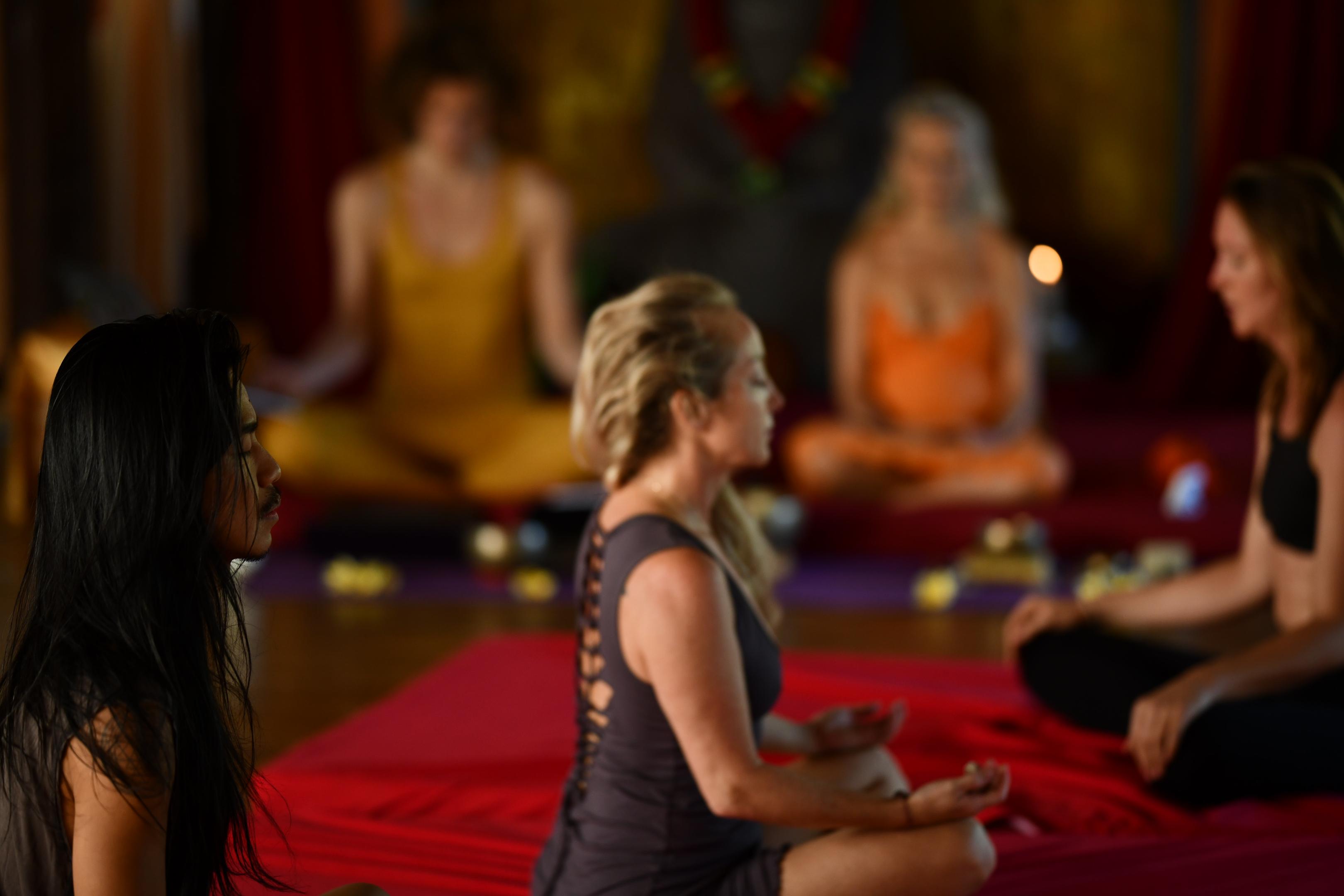
The master key, across all traditions and across all of human history, is meditation.
There needs to be an ongoing commitment to witnessing your own experience without flinching and meeting what arises in the mind and body with openness instead of resistance. This practice, sustained over time, creates an alchemy of consciousness that nothing else can replicate. It is the foundation beneath all spiritual progress.
And when meditation is combined with love, as it is in Tantra, the path becomes very direct, simple, and joyful.
Daily Life as the Laboratory of Enlightenment
One of the most important things I want to say is that enlightenment is not a destination you reach and then rest in forever, separate from the mess and beauty of daily life.
It is a way of meeting daily life.
The enlightenment ideas emerging from the Western Enlightenment were largely concerned with creating better external structures, and these are worthy aims. But the spiritual enlightenment I am pointing toward is about transforming the internal structure and the lens through which you perceive everything.
When that lens is clear, daily life becomes luminous and the ordinary becomes extraordinary. A conversation, a meal, the sound of rain, the face of a stranger, all of it begins to reveal the same underlying truth that existence is a miracle, and that you, in your original nature, are not separate from it.
This is also the foundation of Tantra.
Tantra: Where Love and Meditation Meet
Tantra is the path that brings together the two great forces, including love, which is the feminine principle, and meditation, which is the masculine. By merging opposite polarities, Godliness is experienced as an immediate reality. The oneness hidden behind all duality becomes tangible.
I am often asked: Can Couples Tantra be practiced with someone who is not physically attractive? What if the partner is ill, or strange, or difficult?
This question always makes me smile, because it reveals exactly the conditioning that Tantra is designed to dissolve.
Each person carries within them a God or Goddess nature. It is not visible to the ordinary eye, because the ordinary eye is trained by society, by media, by history, and by self-interest to judge surfaces. But when the third eye opens through meditation and love, what you begin to see in another person is their eternal essence.
There is a story from the Tibetan Tantra lineage that I love deeply. A man seeking initiation arrives at the gate of a monastery. He is met by a hideous old woman who is deranged in appearance, foul-smelling, with sagging skin and missing teeth. He is told only if he can make love to her and see, through and beneath her appearance, the radiant, sublime Goddess, only then will he be allowed inside.
This is a test; can you see through the veil of the conditioned mind to the truth of what is actually present?
Another practice involved a young, physically beautiful couple entering sacred sexual union, while being instructed to simultaneously contemplate the skeleton of each other, the impermanence of flesh, the certainty of death. Because when you can hold both realities at once, including the beauty and the impermanence, the form and the formless, the mind transcends its ordinary categories. Right and left brain integrate. The unified state of Ardhanareshvara, the divine being who is simultaneously masculine and feminine, transcendent and embodied, becomes accessible.
Are You Enlightened?
Many people secretly wonder about this in regards to my journey. Most are too polite to ask. Some bring their own concepts and judgments to the question before the words are even out of their mouths.
Because of the projections and mind games that tend to surround this subject, I have historically said very little about my own experience. But I will say it plainly here, as I do when being asked directly:
Yes.
I say this not to claim superiority or to position myself as an object of reverence. I say it because honesty requires it, and because I believe that living examples of human beings in ordinary bodies, living ordinary daily lives, who have genuinely touched the enlightened state is one of the most important forms of inspiration available to those who are seeking.
It is possible, for you, now, in this very lifetime.
The path is here. The truth has always been here. Beneath the noise of thought, beneath the weight of history, beneath the fear and the conditioning and the ancient karmic knots, your original nature is luminous, free, and waiting.
All that is required is the courage to step onto the path and begin your inner exploration. As Lao Tzu says: “The journey of a thousand miles begins with a single step.”