Sushumna Nadi & the Flow of Energy in the Body
Jun 25, 2026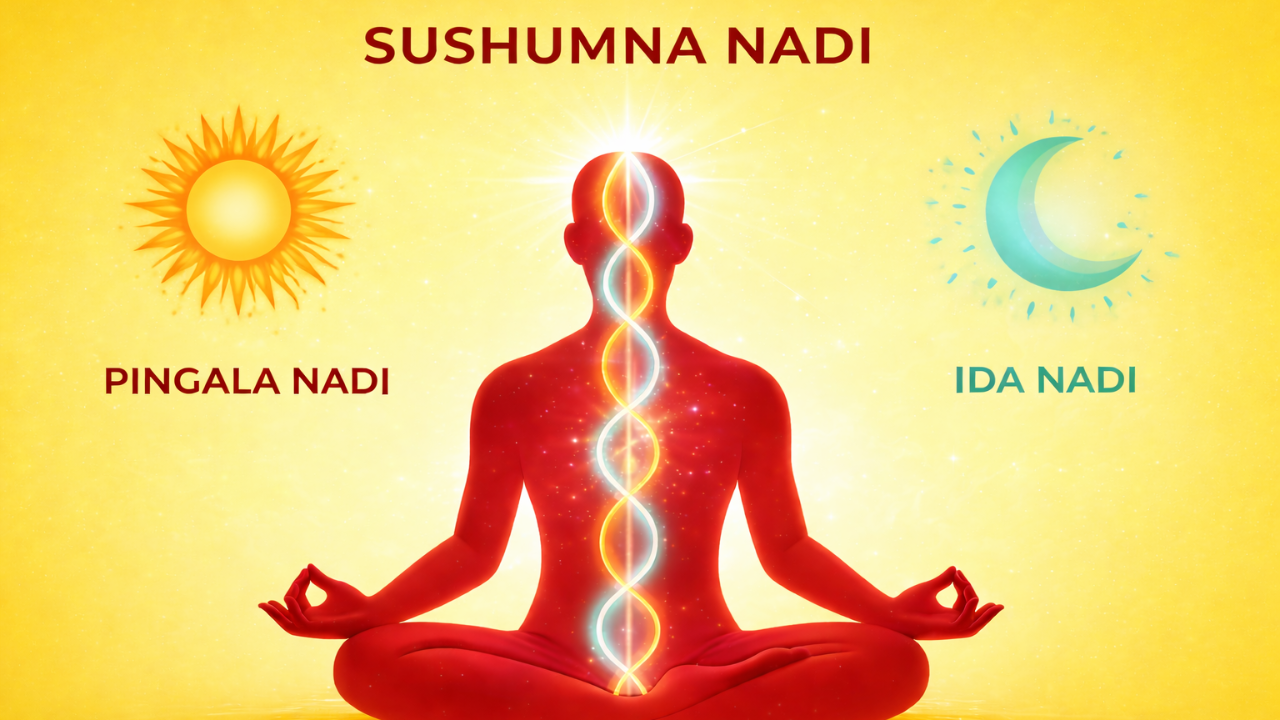
“There are one hundred and one nadis, energy channels, from the heart. Only one goes toward moordha, the crown of the head, and it is called sushumna. By moving into the higher realms through this channel, man becomes immortal.” - Message Beyond Words: A Dialogue with the Lord of Death
Sushumna nadi is the central energy channel of the subtle body. It is a vertical pathway that runs from the base of the spine to the crown of the head, through which kundalini shakti rises during spiritual awakening. In yogic anatomy, the body contains 72,000 nadis, or energy channels, and sushumna is one of the most vital, because it is the axis of the entire system.
Sushumna translates from Sanskrit, meaning most gracious, or very joyful. That name refers to a specific inner state and the quality of awareness that becomes available when this channel is active. Practitioners across traditions describe a steady, clear aliveness that does not fluctuate with circumstances when this channel is open.
In Tantra, Hatha yoga, and Kashmir Shaivism, sushumna is treated as a precise anatomical structure of the subtle body, where it is mapped, studied, and worked with directly, the way Western medicine works with the nervous system. This article explains what it is, how it functions in relation to the other major nadis, what kundalini awakening actually means in this context, and how to begin working with it practically.
Ida, Pingala, and Sushumna
Sushumna works in relationship with two other major nadis, namely the ida and pingala that spiral around it in a double helix pattern from the base of the spine to the nostrils. These three channels form the structural core of the subtle body.
Ida and pingala are the channels of polarity. One is solar, one is lunar. One expands outward, one draws inward. One heats, one cools. Together they govern the oscillating rhythms of human experience and the natural movement between effort and rest, thinking and feeling, activation and surrender. You can observe this dynamic directly in the breath in how the nostrils alternate dominance roughly every ninety minutes throughout the day. When the right nostril dominates, pingala is active. When the left nostril dominates, ida is active.
The central channel activates when ida and pingala reach a state of genuine equilibrium, when solar and lunar, masculine and feminine, active and receptive are so evenly matched that energy has nowhere left to go but through the centre. This is the precise condition that pranayama, bandha, meditation, and Tantric practice are designed to cultivate. When sushumna opens, the energy that ordinarily circulates through the two peripheral channels enters the central axis, moves upward through the chakras, and kundalini shakti begins its ascent. What follows is what the tradition calls an awakening.
Read: Amrita Nadi: The Inner Sun & the Axis of Consciousness
Ida Nadi - The Lunar Channel
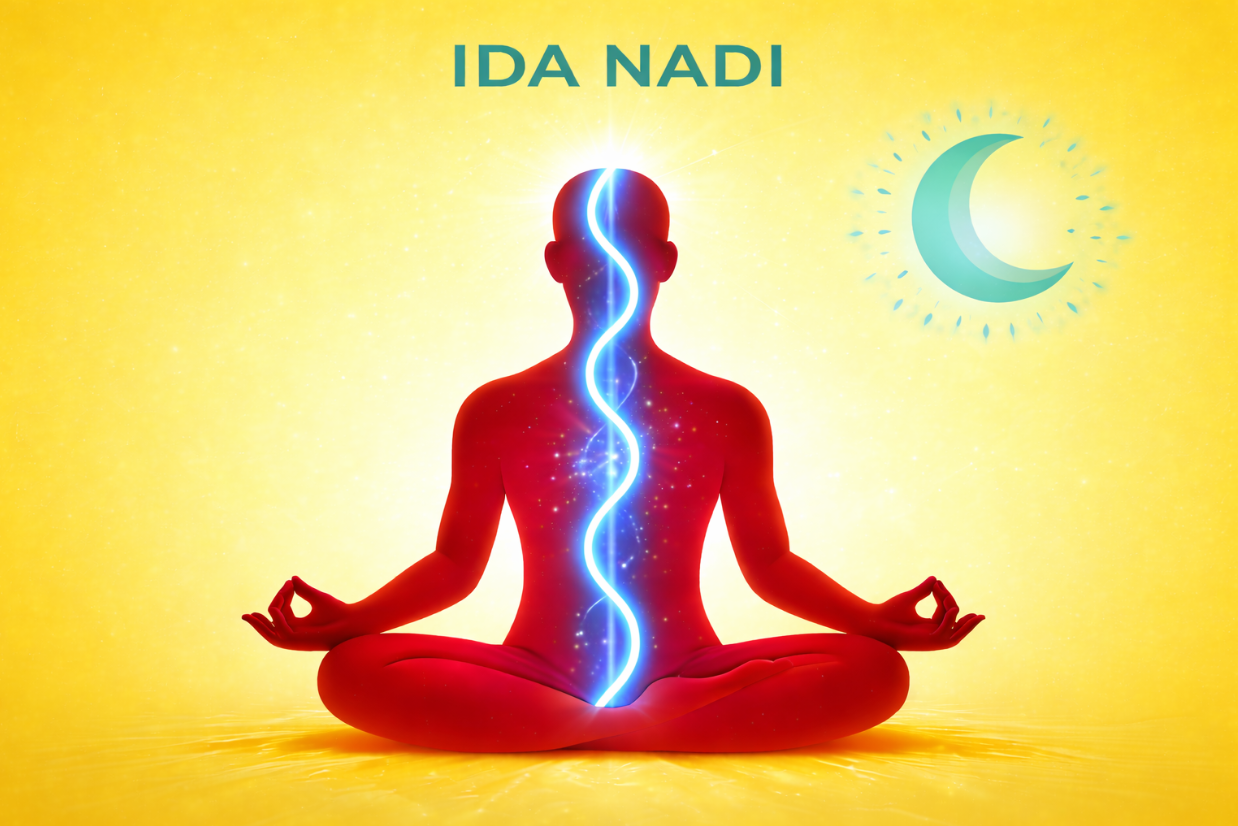
Ida nadi originates at the base of the spine, at the muladhara chakra, and spirals upward around sushumna before terminating at the left nostril. It governs the entire left side of the body and corresponds to the right hemisphere of the brain, which is the hemisphere associated with intuition, spatial awareness, creative thinking, and non-linear perception. In the classical texts, ida is described as chandra nadi, the moon channel.
Ida is cooling, receptive, inward-moving, and feminine in nature. It represents the quality of yielding and of turning attention toward the interior. When ida is active, the mind naturally softens its grip on external experience and begins to move inward.
But ida in excess, without the counterbalancing heat of pingala, has its shadows. Prolonged dominance can manifest as low physical energy, emotional over-sensitivity, difficulty taking action, a tendency toward withdrawal that tips from healthy introversion into isolation. The cooling quality that makes ida so valuable for meditation can become dampening when it runs unchecked. In the language of Ayurveda, this corresponds to an excess of kapha.
In tantric practice, ida nadi is specifically activated through left-nostril breathing, through cooling pranayamas such as chandra bhedana, through yoga nidra, through yin-style asana, and through practices that cultivate receptivity and surrender. It is the channel most naturally active at dusk, during the new moon, and in the hours before sleep, which are times when the tradition recommends turning inward and allowing the day's accumulations to settle.
Pingala Nadi - The Solar Channel

Pingala nadi originates at the base of the spine alongside ida, at muladhara chakra, and spirals upward around sushumna in the opposite direction before terminating at the right nostril. It governs the right side of the body and corresponds to the left hemisphere of the brain which is the hemisphere of logic, language, analysis, and sequential thinking. In the classical texts it is called surya nadi, the sun channel.
Where ida is cool and inward, pingala is warm and outward-moving. Its qualities are those of solar energy in its most direct expression it is activating, energising, clarifying, and expansive. When pingala is dominant, attention moves naturally toward the external world. There is a readiness for action and for engagement with tasks that require focus and directed effort.
Activation of the solar channel generates heat in the body, known as tapas, in Sanskrit, the inner fire that burns through stagnation and purifies the system. Many of the more vigorous practices in Hatha yoga and Tantra are specifically designed to stoke pingala through right-nostril breathing, surya bhedana pranayama, kapalbhati, dynamic asana sequences, and practices done at sunrise or midday, when solar energy is naturally strongest.
Pingala in excess, however, also has its own shadow. When the solar channel dominates chronically as it does for most people living in high-demand modern environments, the result is a system running perpetually hot. This then results in inflammation, irritability, scattered mental energy, difficulty switching off, insomnia, and a restlessness that makes genuine stillness feel threatening rather than restful. In Ayurvedic terms this is excess pitta which means there is too much fire, and not enough cooling moisture to contain it.
Practical Steps to Establish Sushumna
- Establish your seat and observe the starting state. Sit upright in a stable, comfortable position with your spine naturally aligned. Your body should be relaxed but not collapsed. Let your face, jaw, and shoulders soften so the nervous system relaxes without effort. Before doing anything else, bring your attention to the base of the nostrils and observe the breath flow carefully, especially around the nose bridge. You will notice that one side is more open, this is the active nostril, while the other is slightly reduced, which is the passive nostril. This is your current nostril dominance, and it directly reflects how energy flowing through the energy channels is organised in that moment.
- Begin nadi shodhana with controlled, even breathing. Bring your right hand up and gently close the right nostril with your thumb. Inhale slowly through the left nostril for a count of four, keeping the breath smooth and continuous. Then close both nostrils briefly, release the right side, and exhale through the right nostril for four. Without pausing too long, inhale through the right nostril for four, close both nostrils again, and exhale through the left. This completes one round. Continue in this pattern for at least ten rounds. The breath should be even on both sides so that the energy pathways begin to stabilise. As you continue, the alternating pattern begins to balance the main channels, allowing life force energy and shakti energy to redistribute more evenly through the energy body.
- Track the shift toward balance in real time. As the rounds continue, keep checking the sensation of airflow at the nostrils. You are looking for the point where the breath begins to flow equally on both sides. It is a clear physical change in the breath flow. When this happens, the usual dominance of left or right reduces, and the system is no longer strongly oriented in one direction. This is the moment where the two lateral energy channels are balanced enough for the central channel leading through the spine to become active. This shift marks the beginning of sushumna breathing. You may also notice a change in your internal state where it becomes easier to remain focused without effort.
- Shift attention along the nose bridge toward the ajna chakra. Once the breath is balanced, bring your attention more precisely to the nose bridge and the space just above it, associated with the ajna chakra. With each inhale, follow the actual sensation of the breath moving upward from the nostrils toward this point. Keep the attention continuous and grounded in sensation. This begins to guide energy flowing away from the outer energy pathways and toward the centre. As this continues, awareness often becomes more stable and may naturally deepen, requiring less effort to maintain.
- Introduce the soham rhythm to stabilise attention. Allow the breath to settle into its natural pace and begin to notice the subtle sound it makes. On the inhale, mentally register “so,” and on the exhale, “ham.” There is no need to control the breath or repeat the sound forcefully. The purpose is to keep awareness aligned with the midline so that attention does not drift outward again. This supports sustaining awareness and strengthens the conditions for stable sushumna breathing.
- Recognise the physical and energetic changes in the body. As the system continues to balance, the body will often gradually relax in a deeper way than simple rest. The breath becomes finer, and mental activity reduces. At this stage, some people begin to feel subtle cleansing and nourishing sensations moving through the spine or torso. These reflect changes in how life force energy is distributed through the energy body, with less emphasis on the lateral channels and more coherence along the centre.
- Use timing to support the process. Practising at dawn or dusk is especially effective because the body naturally moves toward balance at these times. It becomes easier for the breath to flow equally, which makes access to the central channel leading toward the crown chakra more available. A consistent daily practice of fifteen to twenty minutes, with ten minutes of alternate nostril breathing followed by five minutes of focused attention along the nose bridge or so’ham is enough to create steady progress.
Resources, Further Reading, and Next Steps
Roots of Yoga — by James Mallinson and Mark Singleton
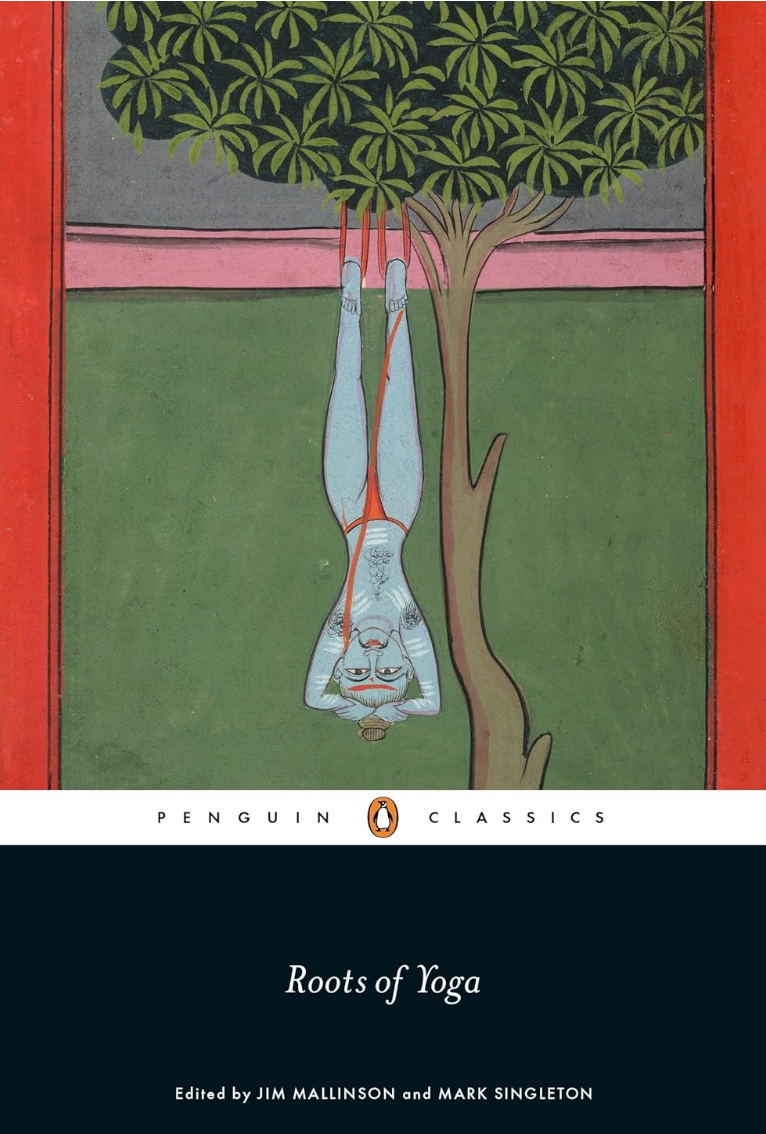
This book is a collection of original yoga texts, translated into English. It shows what early practitioners actually said about the principal nadis, breath, and meditation.
In the sections on pranayama and the subtle body, it explains how the left nostril and right nostril alternate, and how balancing the two nostrils allows the central stream to activate along the spinal cord. It also gives the original meaning of the word sushumna, showing that it refers to a stable, centred state.
This makes it useful because you see that establishing sushumna was always based on balancing ida and pingala nadi, not forcing anything. It gives you the foundation of the system in its most direct form.
Kundalini Yoga by Swami Sivananda
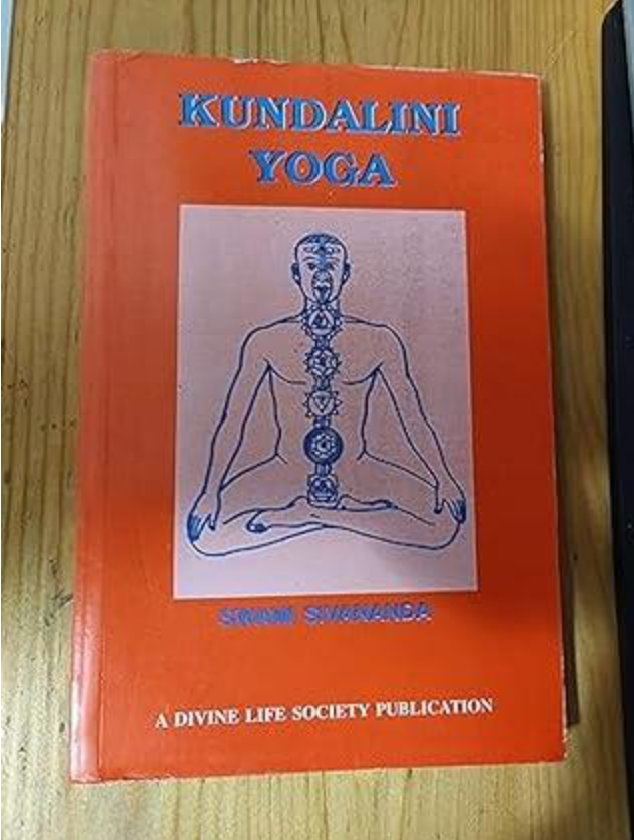
This book explains how the body, breath, and energy system work together. It clearly describes how pingala nadi connects to the right nostril, and ida to the left nostril.
It shows that at any time, one nostril will be more open. When the right nostril is dominant, the system is active and outward. When the left nostril is dominant, the body becomes quieter and more inward.
The book then explains how practices like nadi shodhana pranayama help balance the two nostrils. With regular practice, the breath becomes more even, and these are real, physical changes in the body. When this happens, the central stream becomes active. This is how sushumna is developed in a practical way.
The Complete Illustrated Book of Yoga by Swami Vishnudevananda

This is a practical guide to yoga practice, including postures, breathing, and meditation. It explains how the position of the body, especially along the spine and base (the root chakra), affects how energy moves. When the body is stable and firmly rested, the breath becomes more balanced between the left nostril and right nostril.
The book shows how breathing practices help balance ida and pingala nadi, which leads to better focus and deepening concentration in meditation practice. Over time, the system becomes more stable, and the central stream becomes easier to access.
Theories of the Chakras — by Hiroshi Motoyama

This book explains the chakra system and the three principal nadis in a clear, structured way.
It shows how the central stream runs along the spinal cord, and how imbalance between ida and pingala nadi keeps the system shifting between left and right. It also explains how the breath, especially through the two nostrils and around the nose bridge, reflects what is happening inside the body.
FAQ
What happens when sushumna nadi is activated?
When the sushumna nadi becomes activated, the breath begins to move evenly through both the left nostril and right nostril, with little or no nostril dominance. This can be felt clearly under the nose bridge.
In the body, there is stability and less internal fluctuation. The mind becomes quiet, the mind rests, and attention can simply maintain itself without effort. This creates a steady meditative experience and often a calm, joyful mind.
Which nadi is more powerful?
Out of the 72,000 energy channels in the body, three are considered the most important, namely ida, pingala nadi, and sushumna. These are the main nadis because they regulate how energy moves through the entire system.
Ida, linked to the left nostril, and pingala nadi, linked to the right nostril, are responsible for the normal functioning of the body. They control the constant shift between inward and outward states. This is what you experience as nostril dominance, where either the left nostril or right nostril becomes the active side at different times.
Sushumna is different from these two. It is the central channel that runs along the spine, and it becomes active only when ida and pingala nadi are balanced. As long as energy is moving mainly through the left and right sides, the system remains in this alternating pattern.
How to balance sushumna nadi?
To balance sushumna nadi, you first need to balance the two main energy channels on either side of it, the ida and pingala nadi.
At any moment, one side of the breath will dominate. Either the left nostril or the right nostril will be more open. This is called nostril dominance, and it shows which side of the system is active. If one side stays dominant for too long, the system remains unbalanced, and the central channel cannot activate.
The first step is to regulate this. Use simple breathing practices to bring the left nostril and right nostril into balance, especially if one side feels stronger or the other seems to feel plugged. You can check this by feeling the breath under the nose bridge and noticing which side has more airflow. The aim is to gradually bring the breath to move evenly through both sides.
At the same time, the body needs to be stable. Keeping the spine upright and steady, and grounding through the base of the body (the root chakra), helps reduce unnecessary tension and supports balance in the system.
What are the symptoms of sushumna awakening?
The symptoms of a sushumna awakening include clear, physical changes in the breath, the body, and the mind.
The most direct sign is in the breath. The air flows evenly through both the left nostril and right nostril, with no clear active side. This is a shift away from normal nostril dominance, where one side usually leads. You can feel this balance clearly under the nose bridge.
In the body, there is a sense of steadiness and integration. Tension reduces, and the system feels more stable as a whole. The body is not being pulled between opposing states, and everything feels more settled.
In the mind, there is a noticeable quieting. Attention becomes easier to hold, the mind rests more naturally, and there is less pull toward worldly affairs or distraction. Instead of constant movement, there is clarity and a calm, joyful mind.