Menopause & Astrology: Is This Transition Written in the Stars?
Jun 30, 2026
Menopause is a natural transition. It is a stage the body moves through the same way it moves through puberty and other turning points, with its own rhythm and its own intelligence. Across these years the body reorganizes itself around a new hormonal balance, and it does so on purpose. Seen clearly, menopause is a normal passage of life rather than an illness, and the body already knows the way.
The sky tells the same story. The slow cycles of the planets gather across exactly these years and mark the passage as a real and meaningful one. Astrology and the body point in the same direction: a season of change that arrives on time and settles into something new.
The Saturn Return and Chiron Return
Astrology's calendar is really astronomy. Each planet has an orbit of fixed length, the same for everyone alive, so the major transits arrive at the same ages for every person. Saturn returns every 29.5 years, Chiron about every 50, Jupiter close to every 12, the lunar nodes every 18.6, and the progressed Moon every 27. Menopause unfolds across roughly the ages of 35 to 65, with the final period falling on average near 51, and that window happens to be one of the busiest stretches of transit in a whole life.
The Arc From 35 to 65

The change unfolds gradually across thirty years, and each phase carries its own quality.
Through the late thirties and into the early forties, fertility begins to shift and hormone levels start to move in wider swings. This early phase, often called perimenopause, brings cycles that vary in length and feeling as the body begins its reorganization.
Around the late forties and into the early fifties, the shift reaches its most active phase. Cycles space out and then complete, and the average age for the final period sits near 51. This is the window where the body adjusts most visibly, and signs such as warmth, changes in sleep, and changes in energy tend to appear here.
Through the fifties and into the early sixties, the body settles into its new balance. The active signs ease as the system finds a steady baseline, and by the early sixties the transition has generally completed and the body rests in its new state. The whole arc moves from gradual change, through an active center, into calm.
Read: Menopause Spiritual Meaning: Awakening the Second Spring
The Western sky across these years
Western astrology reads the span from 35 to 65 as one long initiation, marked by a chain of major transits that frame the whole bodily passage.
Near age 37 a nodal return refreshes the axis tied to life direction, an early signal that a new chapter is forming. Around ages 40 to 42 the Uranus opposition arrives, the classic midlife awakening that invites a person to live more fully as themselves, joined near 41 by the Neptune square Neptune aspect, which opens a more spiritual and reflective view. Age 44 brings the second Saturn opposite Saturn opposition, a clear look at the life built so far and a refining of what truly belongs. Near 47 a Jupiter return ripens a person's sense of purpose and meaning.
Age 50 holds the center of the whole arc, which is the Chiron return, an event that happens one time in a life. Chiron is the wounded healer of Greek myth, the figure whose own injury became the source of his power to heal others. At this return the idea is that a person turns long experience into wisdom and steps into the role of guide. It lands right inside the menopause years, which is why Western astrologers connect the two so closely.
For menopause itself, the Moon carries the clearest meaning. In Western astrology the Moon rules the womb, the monthly cycle, and the body's rhythms, so the second progressed lunar return near age 54 reads as a graceful handover from one body rhythm into a new one. A nodal return near 55 resets life direction again, and the second Saturn return near 59 marks the full step into elderhood, with a Jupiter return arriving in the same window to add a fresh sense of meaning. The waning Uranus square near 63 completes the awakening that began in the early forties. Across the whole span the sky describes one continuous movement: a woman gathers the fruit of her experience and begins to carry it as authority.
The Vedic sky across these years
Vedic astrology, called Jyotish, brings a second lens of great depth. Its signature tool is the Vimshottari Dasha, a sequence of timed planetary periods that together span 120 years. Each planet rules its own block: Venus 20 years, Saturn 19, Mercury 17, Jupiter 16, and so on through the full set. The period a woman lives through across these years depends on her own birth chart, set by the position of the Moon at her birth, which makes it the most personal layer of all. Many women move from one period into the next somewhere inside this span, an event Jyotish honors as a true turning point.
Several Vedic markers arrive on a shared schedule. A Jupiter return near age 47 ripens purpose, and another near 59 deepens it. The Rahu and Ketu return near 55 refreshes the karmic axis. For about one woman in four, these years also hold Sade Sati, a transit of Saturn lasting seven and a half years across the signs around the natal Moon, known as a season of deep growth and maturing.
The clearest Vedic idea speaks the language of life stages. The tradition divides a full life into four stages called ashramas. The years up to about 50 belong to Grihastha, the householder stage of family and work. Around age 50 begins Vanaprastha, the stage of turning inward toward reflection, wisdom, and spirit. Menopause marks the body's completion of the householder chapter, and it lines up with this stage with quiet precision. For the physical change itself, a Vedic astrologer reads the Moon, called Chandra, for the body and mind, together with Mars, called Mangala, for the blood.
What Happens For Men
The planetary transits belong to everyone. A man passes through the same Uranus opposition near 42, the same Saturn opposition near 44, the same Chiron return near 50, and the same second Saturn return near 59, because these cycles follow the planets rather than the body. In Vedic terms a man moves through the same ashramas, leaving Grihastha and entering Vanaprastha around 50 in the same way. So the larger story of midlife reflection and the step into elderhood belongs equally to men and women, and the sky marks it for both.
The difference lives in the body. The Moon's connection to the womb and the monthly cycle makes the lunar layer specific to a woman's menopause, the one clear and defined transition that closes the reproductive chapter. A man experiences a gentler and more gradual hormonal change across these same years, a slow and quiet adjustment that varies widely from one man to the next. Both move through the same season in the sky. The woman's body marks it with a clear and recognizable passage.
How Life Unfolds, & What To Expect

Placing the two skies side by side reveals one shared message. Western astrology runs from the Chiron return to the second Saturn return, the path into elderhood. Vedic astrology moves into Vanaprastha, the turn toward wisdom.
Both describe the same unfolding: the reproductive chapter completes, and a chapter built on authority, insight, and inner depth begins.
For a woman this offers a clear sense of what to expect. The forties bring the first gradual changes. The years around 50 bring the most active phase, supported in the sky by the once in a lifetime Chiron return. The fifties and early sixties bring settling and a new steadiness, matched by the second Saturn return and the move into a wiser stage of life. The body and the stars move together toward the same destination: a fuller, steadier authority that the years have earned. Older cultures held one word for this place, the Crone, used with respect as a keeper of wisdom and power in her community.
Read: Navigating Sexuality and Menopause: Challenges and Solutions
Through the lens of Menodawn
At Menodawn of Tantra Essence we view menopause as a natural transition that the body and the stars move through together. We hold it within the body's systems view, where each tradition describes the same change from its own angle and points toward the same gentle support.
What Each System Says Menopause Is
The traditions of natural medicine each describe menopause as a turning of energy from outward reproduction toward inward depth, and each maps neatly onto the astrology above.
- The modern physiological view sees a recalibration of the whole endocrine system, wider than the ovaries alone, as the body shifts from a monthly, cyclic mode of operation into a steady and continuous one. That single move, from rhythm into constancy, mirrors the progressed Moon completing its cycle and handing the rhythm to Saturn, the planet of structure.
- Chinese medicine counts a woman's life in cycles of seven years and places this change at the seventh of them, near 49, when the reproductive essence called Tian Gui recedes and the vessels that carried menstruation grow quiet. The essence that once left the body each month now turns inward to nourish the heart and the spirit, a stage many lineages call a second spring. This inward turn is the same one the Chiron return and Vanaprastha describe.
- Ayurveda divides a life into three seasons ruled by the doshas: the moist growth of Kapha in childhood, the fire of Pitta through the adult and reproductive years, and the air and space of Vata in the elder years. Menopause is the move from the fire season into the air season, toward lightness, spaciousness, and spirit. Since Ayurveda and Vedic astrology grow from one root, this is the very same movement as Grihastha into Vanaprastha.
- Taoist Inner Alchemy names the change of the transforming of the red dragon: the blood once spent each month is conserved, and that vital essence refines upward from essence into energy and spirit. The tradition sees a woman past her fertile years as well prepared for cultivation, an idea that echoes the distilling of experience into wisdom in the Chiron return and the mastery of the second Saturn return.
- In the Chakra View the creative power that sits in the lower centres, the root and the sacral seat of fertility, lifts free of its reproductive task and rises to the heart, the throat, the brow, and the crown, so that the energy which once made children now makes vision, voice, and leadership. This rising is the gift of the Chiron return and the clear authority of the Saturn return.
- Across all of these, one point recurs: the experience of menopause follows emotional life, relationships, and meaning together with hormones, and women in cultures that honour the elderly, report an easier passage. Meaning reaches directly into the body, which is precisely what astrology offers.
Why This Stage Exists in Life

Menopause is one of the wonders of human biology. Humans are among the very few species, alongside orcas and pilot whales, whose females live for many decades after their fertile years. The grandmother hypothesis holds that this long life was favoured because grandmothers, by feeding and teaching and caring for the young, raised their grandchildren's chances of survival. By this account menopause is a built feature of human life, a stage that earned its place. The older cultures recognised the same thing and gave the woman who reached it the honoured name of crone, the keeper of memory and counsel, the very figure the astrology describes as the Chiron healer and the Saturn elder.
At Menodawn we hold one more idea. Menopause is the greatest opportunity a woman is ever given to awaken spiritually and to meet her deepest self. For most of adult life the body's energy is bound to the work of reproduction and the raising of a family. When that work completes, the same energy is set free, and nature opens a clear window, for women and for men alike, in which everything aligns to support the turn inward, the dive within toward the self. The body has already prepared the ground, since every system of natural medicine describes this stage as the moment energy stops flowing outward and begins to rise toward spirit. What the traditions call the second spring, the lifting of essence to the crown, the season of air, is in plain terms the freeing of a woman's life force for the deepest work a human being can do.
Both astrological streams record this window with striking clarity. In the Western chart the slow planets that govern midlife are exactly the planets of the inner and the sacred. The Neptune square near 41 opens the channel to the mystical and the transcendent and softens the hard edges of the worldly self. The Chiron return near 50 heals the oldest wound and turns a life of experience into spiritual wisdom. The returning nodes reset the soul's own axis, the line the chart uses to mark the direction of inner growth. Read together, these are the transits of a person whose attention is being drawn, by the sky itself, from the surface of life toward its depth.
The Vedic stream is even more explicit, because liberation is written into its very structure. Vedic philosophy names four aims of a human life, and the first three, duty, prosperity, and desire, are the work of the householder years, and the fourth and highest, Moksha, the freeing of the soul, belongs to the years that follow. The ashramas carry the same arc: Vanaprastha near 50 turns a person from the marketplace toward reflection, and the final stage, Sannyasa, gives the later years wholly to the search for liberation. The planets agree. Ketu, the south node that returns near 55, is the great significator of Moksha in Jyotish, the planet of detachment and spiritual release, and Saturn, whose second return crowns this decade, rules the discipline and inwardness of the seeker. The chart even keeps a house for this, the twelfth, the house of liberation and of the merging of the self into something larger. In the Vedic reading the second half of life carries one true purpose, and that purpose is Awakening.
So the window is real in both skies, and menopause is its bodily doorway. The completion of fertility is the beginning of the freedom to seek, and the same stars that close one chapter open, in the very same years, the chapter of the spirit.
Why Menodawn of Tantra Essence

Menopause is a natural transition, written into the body and mirrored in the sky. The orbits are real and their timing is exact, and the meaning each tradition adds turns a body change into a step into authority and wisdom. The body knows the way, the stars mark the path, and the whole passage settles into something new and steady.
The body, the Western chart, the Vedic chart, and every system of natural medicine describe a single event: the reproductive and householder phase drawing to a close and a phase built on wisdom and authority opening in its place. At Menodawn we meet menopause through exactly this lens, as the natural and well-supported transition it is, so that a woman can move with the current of her own life into her fuller and wiser years.
Become a Tantra Essence certified Menodawn coach with our new online “The Menodawn Method, a Professional Training of Tantra Essence”
Further Reading: Two Books for the Journey
Wise Power: Discover the Liberating Power of Menopause to Awaken Authority, Purpose and Belonging
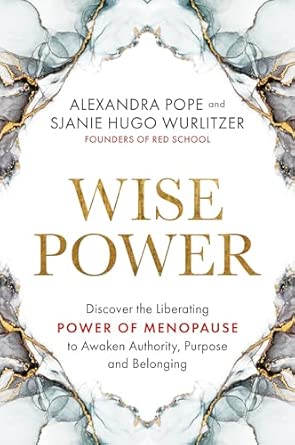
Alexandra Pope & Sjanie Hugo Wurlitzer
Alexandra Pope and Sjanie Hugo Wurlitzer are the founders of Red School and pioneers of what they call the menstruality revolution, a movement to restore the sacred intelligence of the feminine cycle to the centre of a woman's life. In Wise Power they bring that same depth of vision to menopause itself, reframing it entirely: away from crisis, away from something to be managed or medicated, and toward its true identity as one of the great initiations available to a human being.
The book speaks the same language as the planetary transits explored in this article. The authority that Saturn bestows at his second return, the liberation that Uranus has been building toward across the whole midlife arc, the healing power that Chiron distils from a lifetime of experience.Wise Power names all of this in its own rich vocabulary, offering practical tools and a profound new story to carry a woman from perimenopause all the way into her fully inhabited elder years.
The Seven Sacred Rites of Menopause: The Spiritual Journey to the Wise-Woman Years

Kristi Meisenbach Boylan
Kristi Meisenbach Boylan wrote this book from the other side of her own menopausal transformation, and the lived quality of that passage radiates from every page. Her central understanding is one the Tantric and astrological traditions have always held: that menopause is a soul event first, and a physical event second. The seven ceremonial milestones she maps are invitations — moments on the journey where a woman can choose to reflect, to embrace, to release, and to step into something she could only have become by living all of this.
The book pairs with particular beauty alongside the Chiron return material in this article. Chiron asks a woman to turn her wounds into wisdom and her experience into the gift of healing for others. Boylan's seven rites are, in essence, a practical and ceremonial guide to doing precisely that, moving through shame, grief, and the shedding of old identities with conscious awareness, arriving at the wise woman years with her full power intact.