How Motherhood Has Shaped Anurasa’s Tantric Practice
Jan 20, 2026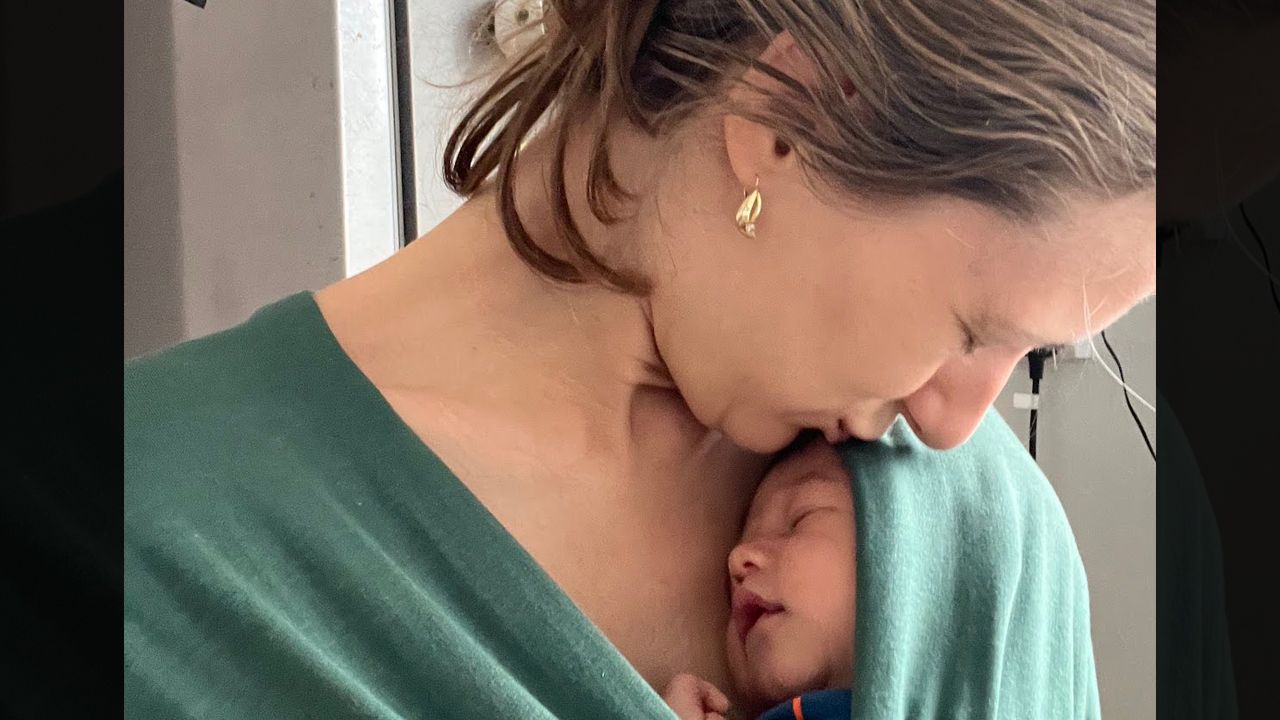
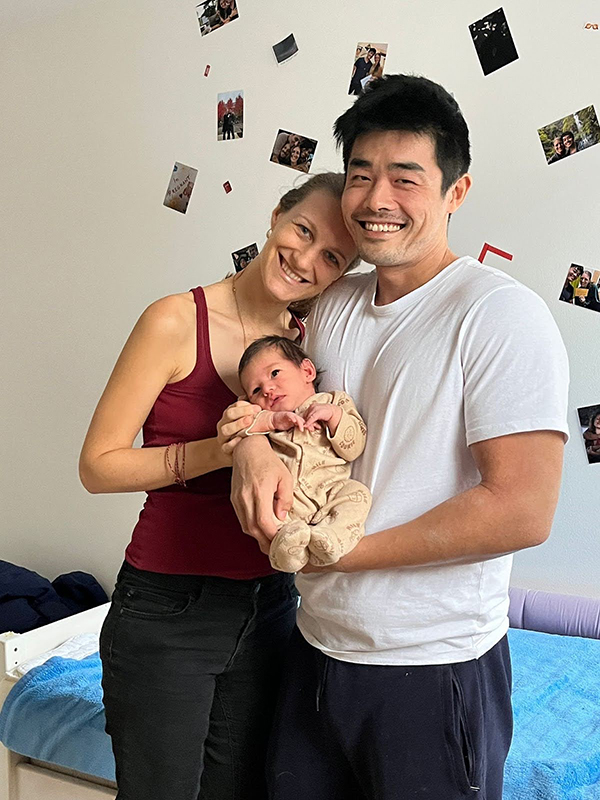
I want to begin by introducing Nritya Anurasa, a woman whose path has become an integral part of our Tantra community. Anurasa joined us in 2020, and very quickly her dedication and understanding of Tantra made her a natural teacher within our school. She went on to guide students through Goddess Essence and The Tantra Inner Mastery Series.
In 2025, Anurasa led retreats while pregnant, showing in real time, what it looks like to integrate Tantra inside the realities of a changing body and the experience of motherhood.
Now that she has fully stepped into motherhood herself, she continues to live the message that Tantra is part of daily life; it is a practice that moves with us, especially in the moments that stretch us the most.
She will return to teaching in 2026, and we are genuinely excited to witness how this new chapter shapes her work.
The reflections below are written by her. They are direct accounts of her experience of the first few weeks of becoming a mother, and how this journey is unfolding for her.
Below, in her journaling and reflections she shares the inner truth that emerges when motherhood becomes a living initiation.
Tantra, Parenthood, and Osho’s Teaching
Within many Tantric traditions, the path of awakening has long been understood as one that thrives in spaciousness and the dissolving of personal attachments. Parenthood, with its constant needs and relentless devotion, was often viewed as something that disrupts this inner work. If a practitioner is constantly tending to a child, where is the uninterrupted silence for meditation? Where is the depth of inner exploration?
Osho spoke directly to the complexity of raising children while on a spiritual path. He emphasized that unless a person has done profound inner work, their unresolved patterns will inevitably spill into the next generation.
Osho said clearly:
“First finish your work upon yourself. When you have come to a certain state where you know now nothing can disturb you, then it is perfectly good to have children… Right now you yourself need mothering and you will be simply giving them all the diseases that you’re carrying.”
— Osho, The Open Secret, Talk #16
He cautioned that without self-awareness, parents unconsciously pass on what he called NDD, which is neurosis, disease, and depression.
His teaching is not anti-parenthood; it is a call for inner maturity. A call to become spacious enough, healed enough, stable enough, that a child receives your conscious and awakened presence rather than inherited pain.
Anurasa is a woman who devoted years to her Tantric practice before stepping into motherhood. She has done years of emotional release work, embodiment training, relational honesty, trauma unwinding, nervous system regulation, and deep feminine initiation.
Because of that, she entered parenthood as a woman already rooted in her own center. She holds her family from a place of conscious presence. Her son is receiving her attunement and the safety she painstakingly cultivated through her practice.
This doesn’t mean her path is effortless. Motherhood has stretched her, broken her open, and confronted her with new edges, just as Osho predicted. But because of the inner work she did, she meets these edges with awareness and emotional responsibility.
And what emerges is a new understanding:
Motherhood is not a distraction from Tantra when a woman has done her inner work.
It becomes a legitimate and practical form of Tantric practice.
Anurasa’s journey shows that a child can become a profound catalyst for awakening. Parenting becomes a living sadhana. A child does not obstruct consciousness when a mother is rooted in her inner work. A child expands it.
Anurasa’s Reflection 1: Riding the Storm, Loving the Moments
“When Kailash was around seven to eight weeks old, we went through one of our most intense stretches so far — almost three weeks of cries, exhaustion, clingy days, cry days, tiny pockets of relief… and then the whole cycle repeating again.
Sleep during that time became its own art form. And William and I tag-teamed harder than ever, shifting between holding, bouncing, soothing, feeding, resting in micro-moments, and catching whatever slivers of breath and sanity we could.
But even inside that storm, the glimmers kept breaking through. The play, the smiles, the softness slowly returning.
The tiny sparks of joy that arrive out of nowhere and remind you why your heart said yes to all of this.
The way love deepens even when the days blur into each other.
A Day That Stood Out From That Season
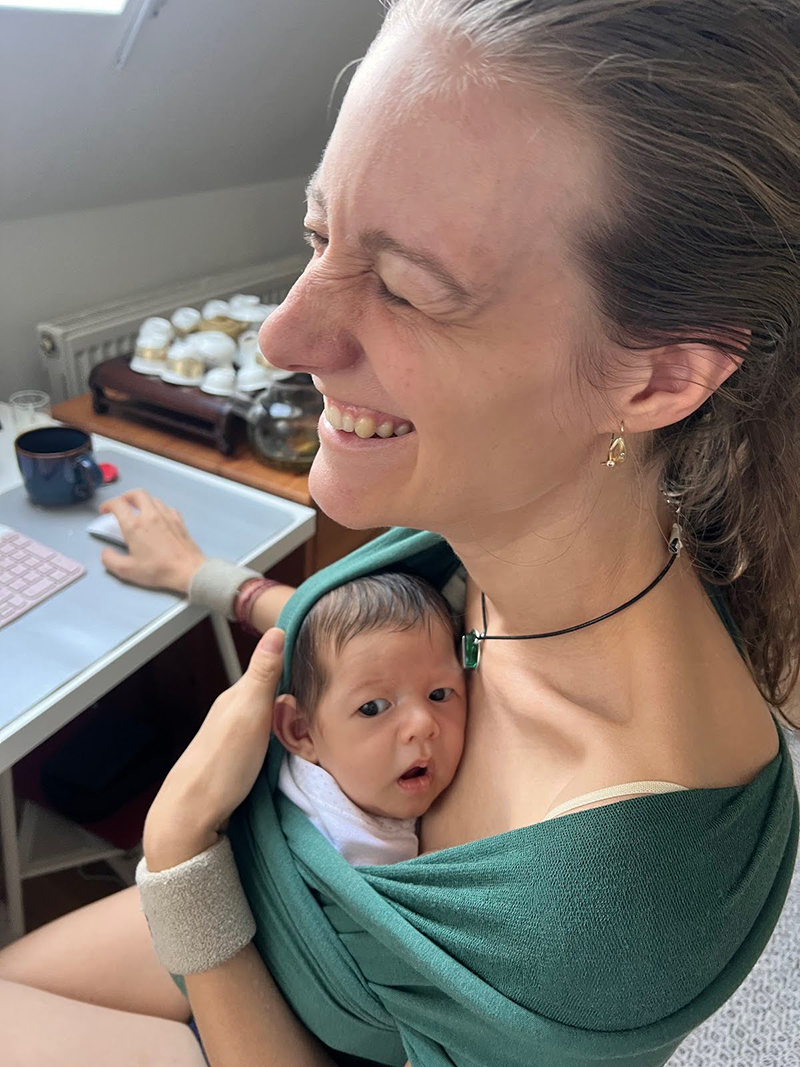
One day in particular held a turning point. Kailash finally fell asleep in the wrap again, the first time in days.
His little body curled into mine, breathing deeply, trusting completely. My whole being softened.
That day I was able to cook and work a little, and also breathe a little. I remembered myself a little. He even slept alone for short pockets and played alone for moments. Back then, these were massive victories in that season of becoming.
Learning to Ride the Storm
That period taught me a deeper level of surrender. Letting go of the illusion of control and learning to meet life moment by moment.
I was choosing to listen instead of force. To adjust instead of overanalyze, and to respond instead of collapse.
I realised that motherhood isn’t about “managing” a baby, it’s about navigating my own internal weather.
Sometimes that weather is sunshine. Sometimes it’s a full monsoon. But that month cracked me open into a new kind of presence.
The Love Grew Even Inside the Difficult Moments
Even in the exhaustion, even when my body ached. Even when time felt formless and days melted into nights. The love kept deepening.
That period bonded us as a family in ways I didn’t know we needed, a raw, real, practical intimacy born not from the easy moments but from the shared initiation of surviving, soothing, laughing, crying, and rebuilding ourselves together.
And the support around us mattered so much. We had friends who brought food. Friends who walked him so we could breathe, and friends who held space so we could shower or reconnect as two humans remembering each other. Those small offerings stitched me back together.
Parenthood Isn’t Linear
Looking back, I see that those weeks were an initiation into the nonlinear nature of parenthood.
It spirals. It expands. It circles back. It breaks you open and pours you into a bigger version of yourself.
The overwhelm is real, but so is the growth, the softness, the expansion, the love.
The love grows in every direction, even in the messy, sleepless, blurry seasons.
Reflection 2: This Is What Tantra Looks Like in Real Life
People often imagine Tantra as candles, rituals, bliss-filled eye-gazing, sensual connection, and sacred intimacy.
And yes, that can be part of it. But what leads you there is something far more human, like nervous system work, tears, breath, edges, and breaking open.
And choosing love again and again, especially when it would be easier not to.
When Kailash was around six or seven weeks old, we went through one of the most intense stretches so far, two full weeks of cries, fussiness, clinginess, and very, very little sleep. It stretched every skill we had.
One night, from 8pm until 12:30am, he cried almost non-stop. There was frantic feeding and every soothing trick was failing. Every strategy was dissolving in my hands.
I was literally coaching myself in real time with ChatGPT between sobs and bouncing and pacing. He cried. I tried. He calmed… and then cried again. In between all this, I had no water, no pee break, and no time to pause.
I was just trying to regulate him and regulate myself; being the anchor, being the still point, being the mother I wanted to be. And then I broke. My system tapped out. I called William with a voice I didn’t recognise. He took him instantly. The moment Kai left my arms, I curled into a ball, sobbing, shaking, letting the storm move through me.
Letting myself be human. Letting myself be held. And in thirty minutes; something I could not do in four and a half hours, William settled him to sleep.
Here we were just two humans doing their best, taking turns, sharing the load.
This, too, is Tantra.
The Next Day
The next day, something clicked. After researching, I realised we had been stretching his wake windows too far and slipping him into overtiredness without noticing.
My intuition said: try again, watch closer. So I started timing his windows and soothing him earlier, and winding him down before the signs of fatigue.
And it worked. He had four beautiful naps!. Two of them not in my arms, but in a swaddle. There was no frantic crying and no overwhelm. Just peaceful drifting.
William and I celebrated in the kitchen like two lunatics who had just won the World Cup, because in that season, this was a miracle.
But the intensity of the experience didn’t vanish, and there was more waiting for us.
A New Storm & New Teachers
Night returned with its own lessons. There was more crying and more overtired cues slipping through our fingers.
William took him for a walk through the cold night. Kai wailed through the neighbourhood. They came back with him still screaming. This time, William broke.
He handed Kai to me and went into the other room and did a pillow-beating meditation which includes breath, sound, and release.
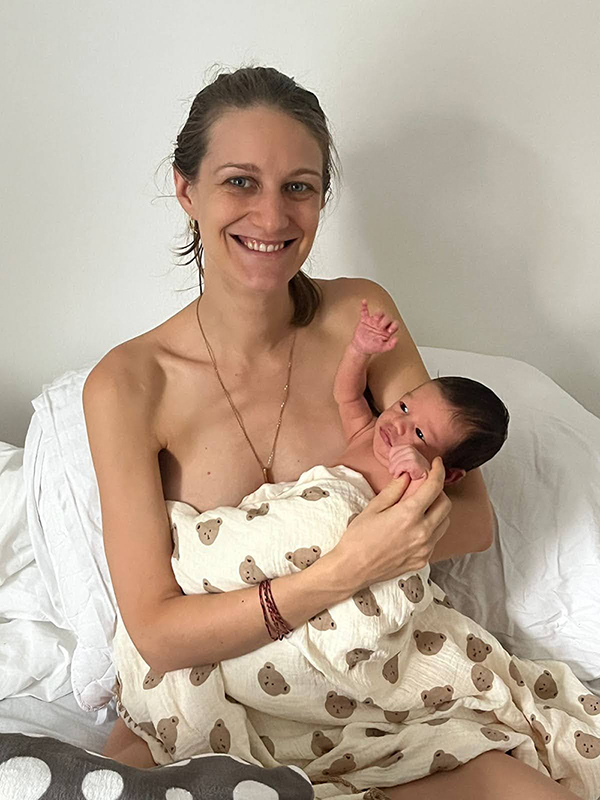
Kai melted into sleep at my breast while my partner processed his overwhelm.
How We Support Each Other (and Ourselves)
From that period, we learned the shape of support in our home:
- We tag-team, not martyr
- We ask: What do WE need?
- We move energy through the body, not releasing pent up emotions at each other
- We regulate each other when one collapses
- We treat hard moments as practice, not failure
- We stay curious instead of blaming
- We repair before sleep, always
This isn’t just for parents. This is what real partnership looks like. This is what emotional maturity looks like. And this is what living Tantra looks like, learning how to stay present inside intensity, how to love inside the storm, and how to return to the body when everything feels impossible.
Reflection 3: Trauma Patterns in Parenting & the Path of Conscious Release
How babies awaken the deepest layers of the nervous system.
No one prepares you for the way parenting hooks straight into the deepest strata of your nervous system. We enter motherhood and fatherhood with our histories, and no one has a blank slate.
I came into this season carrying imprints around abandonment and safety. I had a father who wasn’t there, and a step-father whose anger made love feel unpredictable.
William carries his own story too, and that part belongs to him, not me.
But I will say that nothing activated my old patterns as fast as the cries of a newborn.
When a Baby’s Cry Meets Old Survival Coding
There were moments, especially in the early weeks, when Kailash’s cries pressed directly on ancient triggers.
And when William met his edges, he did what we were trained to do in Tantra, which is conscious emotional release.
This involves not exploding outward, and not directing energy at anyone. And also not suppressing it, either.
But stepping into another room and letting the energy move through the body through breath, sound, and movement.
This is deeply conscious practice. And yet my body remembered danger. Something ancient tightened in my chest and a protective instinct rose around my son.
A whisper from the past asked:
“Is anger safe?”
And this is where the real work began.
The First Time I Encountered Emotional Release
Years ago, when I first came into emotional release work, I was terrified.
The sound of rage, even conscious rage, sent my nervous system into contraction. I didn’t know, then, that there was a difference between destructive anger and liberating anger.
Over time through training, witnessing, breathwork, and constantly expanding my window of tolerance, I learned something that changed my entire life:
Anger expressed consciously is not violence, it is liberation.
Suppression doesn’t create safety, it creates implosion. A regulated nervous system isn’t built by holding everything in, but by allowing everything to complete. That understanding became one of the cornerstones of my healing.
I just didn’t expect it to become one of the cornerstones of my parenting.
And Now Here We Are… With a Baby in Our Arms
Here we are, years later, using the very tools that once petrified me, but this time with a newborn in our arms and absolutely zero room for spiritual bypassing.
Parenthood doesn’t politely ask you to grow. It doesn’t wait until you’ve meditated and journaled and had a full night of sleep. It extracts every unresolved part of your subconscious and hands it to you at 3 a.m., wrapped in a blanket crying with its whole body.
Some days, our nervous systems are saints, being attuned and patient.
Other days, they are caves echoing old ghosts. And yet 95% of the time, we are a deeply attuned unit. It’s the other 5% that teaches us the most.
The Vows We Make
That 5% is where our real commitments live:
- We name what is happening.
- We do not collapse into old stories.
- We protect the safety field for our child.
- We meet our edges consciously, not reactively.
- We choose healing over inheritance.
These are the vows that matter. The vows that prevent the past from becoming the future. The vows that build a lineage of nervous-system safety.
Parenthood isn’t breaking us. It is revealing where we are still afraid, and offering us the opportunity to transmute fear into presence instead of passing it down.
This Is Love in Practice
This is not the soft, dreamy love that exists in imagination but the love that lives in the body:
It is messy. It is sacred. Sometimes shaky, but always honest.
We have a love that meets shadow without flinching. Love that grows precisely where the old wound once lived. Love that refuses to hand inherited pain to the next generation wrapped as “normal.”
This, to me, is conscious parenting. This is tantra in daily life. This is devotion in the raw.”