Surrendering to the Waves: My Sacred Home Water Birth
Dec 08, 2025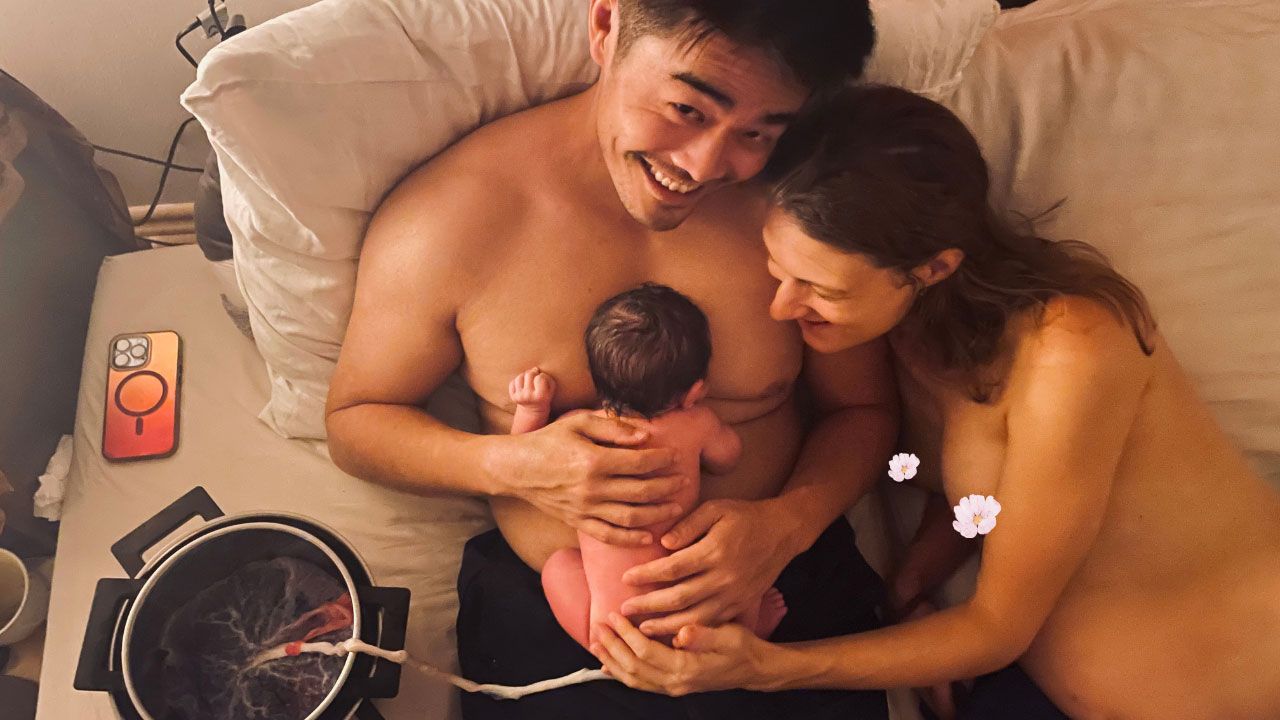
On the evening of September 21st (my due date), I felt my soul was ready for birth. I sat before my birthing altar, surrounded by the soft glow of candles.
The special pink candle I had been saving for this moment burned at the centre, a quiet flame of devotion. I lit incense, closed my eyes, and spiralled my womb and pelvis, breathing trust into every cell.
I called in the elements; fire, earth, air, water, ether.
I visualised the walls around me transforming into an ancient forest, the birthing pool becoming a sacred lake, the ceiling opening into a sky of stars. The candles turned into a great tribal fire. The ground beneath me became grass and soil.
I invited enlightened masters, my teachers, and the goddesses of transformation.
I called in Osho.
I called in Sarita.
I invited my ancestors and William’s ancestors to witness from outside the sacred forest — to watch over us, but not interfere.
And I set my prayer:
✨ May my baby be born as love, through love, into love. ✨
When William came home, he found me glowing in the candlelight. He kissed me softly and sat behind me, holding me in that sacred atmosphere. That moment felt like a seal and a quiet confirmation that we were ready.
The First Phase of My Home Birth in Water
The next day, around noon, subtle waves began to ripple through my body. I still wasn’t sure if it was labour.
My midwife suggested I try an enema and if it was real, contractions would continue. So there I was, in the bathroom, breathing through contractions while giving myself an enema, laughing internally at the ridiculousness and mystery of early labour. Is this it? Or not yet?
When I finished, I walked into the kitchen and calmly said to William:
“I think I’m in actual labour.”
His reaction was priceless.
Slightly panicked, running in little circles, repeating in a high-pitched innocent voice:
“What do I do? What do I do?”
Meanwhile, I stood there breathing peacefully, curious and open.
He called the midwives, and I overheard them soothing him while I quietly rode the waves. It was such a beautiful contrast — my calm and his devoted concern. I still cherish that moment.
As contractions built, William came to me. His caresses — his hands on my back, the way he stroked my hair — were pure medicine. I asked for what I needed:
less pressure, more pressure, here, slower, softer.
Every time, his presence anchored me and the pain softened.
I felt so deeply loved and cherished, melting into his tenderness.
Read: Orgasmic Birth: Conscious Conception, Pregnancy, and Ecstatic Birthing


A Familiar Environment for My Natural Birth
By 4pm, our midwives Marketa and Vladka arrived, assessing without intruding. I’m so grateful I got to have an experience of resting at home, the only intervention is gentle listening to babies heartbeat through my belly. No other exams.
Around 5:30pm, Vladka offered me chocolate cake. Chocolate cake during labour… pure heavenly drooly bliss!.
Cannot recommend enough, that cake never tasted so good, despite only being able to get a bit in between each contraction. Meanwhile, the birthing pool still wasn’t ready.
William battled with the tap connection while my contractions intensified. Eventually I waddled into the kitchen and helped fix the hose between contractions. Everyone laughed, apparently I gained “street points” for that.
Even after hours of waves, I still wondered:
Is this really labour? Could it still stop?
The midwives suggested rest, thinking it might be long. In hindsight, I wish I had moved more, spiralled more, roared more. But when the waves intensified, the movement came, just not the deep spiralling I had always imagined.
Getting Into The Inflatable Tub
In the last moments before transition, a few things unfolded. First, I caught myself resisting. Trying to stop the wave. Trying to push it back.
Then I remembered my ritual. The only way out is through. You must trust and surrender. Enter a flow. As soon as I softened, my body answered. Moments later, another surge arrived, stronger, undeniable. My body began pushing on its own.
I remember thinking, “Ohhh… this is what they mean by your body pushing.” That’s all it took.
I leapt straight for the pool, FINALLY ready, just in time.

My Water Birth at Home
The warm water brought immediate relief… and immediate primal power. My body was pushing. There was no stopping the second contraction after that spontaneous push. Thank god I was already in the pool, my waters exploded.
The pain was immense. I roared like a lion.
Looking back at the videos, I sounded much quieter in reality, but in my head? I was convinced the entire neighbourhood thought someone was being murdered.
Between waves, I worked hard to regulate myself, smoothing my breathing, calming my system, not letting panic take over. All I could do was drool into the edge of the pool as I tried to catch my breath between contractions, though the breaks were not long.
William’s touch and voice were everything. His steady presence, his reminders to spiral, his whispered encouragements, they anchored me. It all happened so fast.
Three to five contractions later, his head was through. The hardest part. It felt like I was going to be ripped open, like my pelvis and anus were merging into one.
The midwives encouraged: “You can touch the head.”
In my head I thought: “I can barely move, all I can do is drool on the edge of the pool.”
But moments later, somehow, I reached down. And felt him. He was hairy, slimy, and real.
Then the next wave hit. The final push was the easiest — and then suddenly, there he was, floating in the water, no longer inside me.


Labor and Delivery
< The polarity of bliss and pain, and the wonder of how they can co-exist.
Delirium washed over me. I heard: “You can lift your baby.” I looked down at the tiny being in the water, scooped him up, and collapsed backward into the pool. Relief flooded me, but so did pain.
I held him close, trying not to let him slip, while my womb contracted sharply. Inside my mind were only two thoughts: “Why am I still in so much pain? Where is that movie moment of bliss?”
and “Is it a boy or a girl?”
I wanted to move closer to William, but couldn’t. Minutes passed before I finally looked.
“Oh my God — it’s a boy!” Shock and joy in one breath.
I had two dreams in pregnancy where a girl came through and said she wanted to be called Eve, so discovering he was a boy was a surprise, but I had intentionally not found out the gender to avoid projecting expectations.
He was born at 6:46 p.m., just over six hours from the first contraction.

Closing Reflections
My birth was not ecstatic. It was primal. Raw and meditative. My body screamed. My voice roared.
But beneath it all, trust held me. The sacred space I had prepared, the prayers spoken, William’s unwavering love, the wisdom of my midwives, they carried me.
Most of my labour was deeply peaceful, nourishing, even transcendental. Sometimes comical and funny. The final stretch was intense, but still magical. Years of meditation, emotional release, and embodiment work became instinct.
All that group-room roaring over the years, healing the places where I once had to be silent was golden training. I felt raw and alive. I worked with my body. And I’m immensely grateful for that.
A few days later, my midwives said:
“It is very rare to see a woman so empowered in her first birth, often not even in the second. It was an honour to witness you through this process.”
Their words touched me deeply.
Inside, I didn’t feel empowered, I felt overwhelmed at times, sad that it wasn’t ecstatic.
But their reflection helped me see how much my years of dedication had woven themselves into my being.
And so our son was born:
As love.
Through love.
Into love.
My prayers were heard. It is the greatest gift I will cherish forever.
I am so grateful to Sarita, my spiritual mother, the one who gave me teachings, tools, and space to grow into the woman I am today. She is the reason I knew about water birth, the reason I healed my own birth trauma, the reason I had the tools to remain calm, aware, loving, and surrendered through the intensity.
This birth was not what I imagined. But it was mine. It was beautiful and powerful.
Recommendations
These were pillars for me throughout pregnancy:
-
The Gentle Birth Method by Dr. Gowri Motha
Recommended to me by Sarita — it was foundational to my smooth pregnancy and labour.
-
Do emotional and spiritual preparation before pregnancy
Get comfortable with emotional release, meditation, and being with discomfort while reaching transcendence. These are the tools that make pregnancy and motherhood a spiritual practice, not a battlefield.
-
Begin Rebirth Probiotics (tip from Ibu Robin Lim)
Saved me from constipation in pregnancy and postpartum. Expensive, but worth it for severe blocks.
-
Tachyon Cocoon for deep rest
My nap lifesaver. I genuinely don’t know how mothers survive without it.
-
Tachyon Pleasure Wand & Tachyon therapies
Incredible for healing pelvic, womb, or emotional tension before birth.
Get 15% discount with ‘Anurasa’ or reach out to me to help you with your order.
More on all of this in future posts.
Stay tuned💛
With deep love and appreciation for your care in reading my journey
Anurasa
(Teaching Inner Mastery Series & Goddess Essence Series in Europe)
If you’d like to follow my tantrik mamma journey keep an eye out for future newsletters here and check out my social media @nritya.anurasa
FAQ
Is it possible to have a water birth at home?
Yes, a home water birth is not only possible, it is an evidence-based option that many women choose when they desire a more natural birth, fewer medical interventions, and a deeply relaxed environment where their bodies can open in their own rhythm.
A water birth at home usually involves a birthing pool, an inflatable tub, or even your own tub, filled with warm water kept at a safe water temperature (usually 36–37°C). The warmth helps ease pain, soften the birth canal, and support a more physiological birth. Research studies and organizations like Waterbirth International have shown that water immersion in the first stage of labor and delivery often leads to less pain, fewer interventions, and higher maternal satisfaction.
How much does it cost to do a water birth at home?
The cost of a home water birth often feels less like paying for a kind of birth experience your body has always known it deserved. Most families work with a midwife or a certified nurse midwife, whose full maternity care package may include prenatal visits, the sacred presence of attended labor and delivery, postpartum support, and gentle fetal monitoring. These offerings typically fall somewhere between $2,500 and $6,000, depending on your region.
The birthing space itself can be simple. Some women choose an inflatable tub or a dedicated birthing pool, while others give birth in their own tub, wrapped in the intimacy of their familiar environment. Supplies like a tub liner and a thermometer for safe water temperature add a small additional cost.
Compared with birth centers or a hospital setting, a birth at home often brings both financial and emotional ease. There are usually fewer interventions, no facility fees, and no extra charges unless a medical emergency requires transfer for something like an emergency c section. For many women, the true value is not in the savings but in the soulful ability to give birth in a warm, protected, heart-led space.
What are the risks of water birth at home?
A home water birth can be a beautiful, evidence-based option when the pregnancy is considered a low risk pregnancy, when the mother is well, and when a skilled midwife or certified nurse midwife is tending the space. Still, every birth carries both mystery and responsibility, and part of stepping into a natural birth is understanding the landscape of possibility.
The warmth of the birthing pool supports a deeply physiological birth, softening the tissues of the birth canal, helping the body flow with the waves of labor, and encouraging a gentle transition for the baby as they emerge from amniotic fluid into warm water. Yet this softening environment requires attentiveness. Cleanliness matters to prevent maternal infection. Intermittent fetal heart rate monitoring helps track how the baby responds. The midwife watches the amniotic fluid, the mother’s tone, and the rhythm of opening.
Some conditions like high blood pressure, certain health conditions, thick meconium, or signs of increased risk may call for moving from home to a hospital setting. Rare complications such as water aspiration, significant blood loss, shoulder dystocia, or a need for rapid intervention remain possibilities in any vaginal birth, whether on land or in water.
Is a home water birth less painful?
For many women, yes. A home water birth often brings a kind of relief that feels ancient and remembered. The warm water wraps around the body like a soft blessing, calming the nervous system, loosening the muscles, easing intensity, and helping each contraction unfold with greater purpose and less resistance. This is why water immersion is known to help women experience less pain, especially during the first stage of labor as they move toward being fully dilated.
The softness of the warm tub or warm bath, combined with the safety of a familiar environment, can create a natural hormonal harmony that even the best hospital cannot replicate. Without bright lights, constant checks, or unnecessary disruptions, the birthing body often opens more fluidly. Many women describe their birth in water as a kind of returning, a way of letting the body do what it knows, with fewer obstacles and more breath.
Research from groups notes that the reduction in tension often leads to fewer interventions, less need for pain medication, and sometimes less perineal trauma or fewer perineal tears. For the birthing person, the result is not a pain-free birth, but a more manageable, intuitive, embodied one, where the rhythm of contractions feels supported rather than battled.