Saraswati: The Goddess of Knowledge, Wisdom, & the Arts
Jan 23, 2026
Saraswati is the Hindu goddess of knowledge, speech, and creative intelligence. She governs your ability to learn, to teach, to speak clearly, to write with authority, and to make sound decisions based on real understanding.
She’s the one you go to when you need clarity. She is precision & articulation and the power to express your truth without losing yourself in emotion or distraction.
She shows up in your life when you’re refining your voice or cutting through confusion to get to the root of a problem.
Origins and Evolution of Saraswati in Hinduism
Saraswati in the Vedic Age
Before she was deified in human form, Saraswati was a river, vast, powerful, and central to the spiritual and geographic landscape of early Vedic civilization.
In the Rigveda, the oldest of the Vedic texts (composed around 1500–1200 BCE), Saraswati is praised as a river of great significance. She is called “the best of mothers, of rivers, and of goddesses,” associated with nourishment and flow. Her waters were believed to sustain and give rise to life. Geographically, many scholars believe the river once flowed through what is now northwestern India, possibly along the path of the now-dry Ghaggar-Hakra river system.
As the physical river began to dry up, possibly due to climatic changes or tectonic shifts, by the time of the Brahmanas and Upanishads (texts composed roughly between 900–500 BCE), Saraswati had become a symbolic and philosophical force, an embodiment of Vak (speech), Vidya (knowledge), and Jnana (understanding).
In the Shatapatha Brahmana, Saraswati is referred to as Vak Devi, the goddess of speech. She represents the force that turns thought into language, and language into understanding. In Hindu cosmology, speech is a sacred force that shapes reality. In this view, Saraswati becomes the bridge between silence and creation, chaos and clarity.
Philosophically, Saraswati governs both Apara Vidya (worldly knowledge, grammar, logic, art, mathematics) and Para Vidya (spiritual knowledge, self-inquiry, metaphysics, liberation). She is the deity who allows for mastery of the external world while also pointing toward liberation from it. In this way, she holds a unique position, she is both the patron of intellectual pursuit and the guide toward ultimate truth (moksha).
Saraswati’s Relationship with the Creator God Brahma
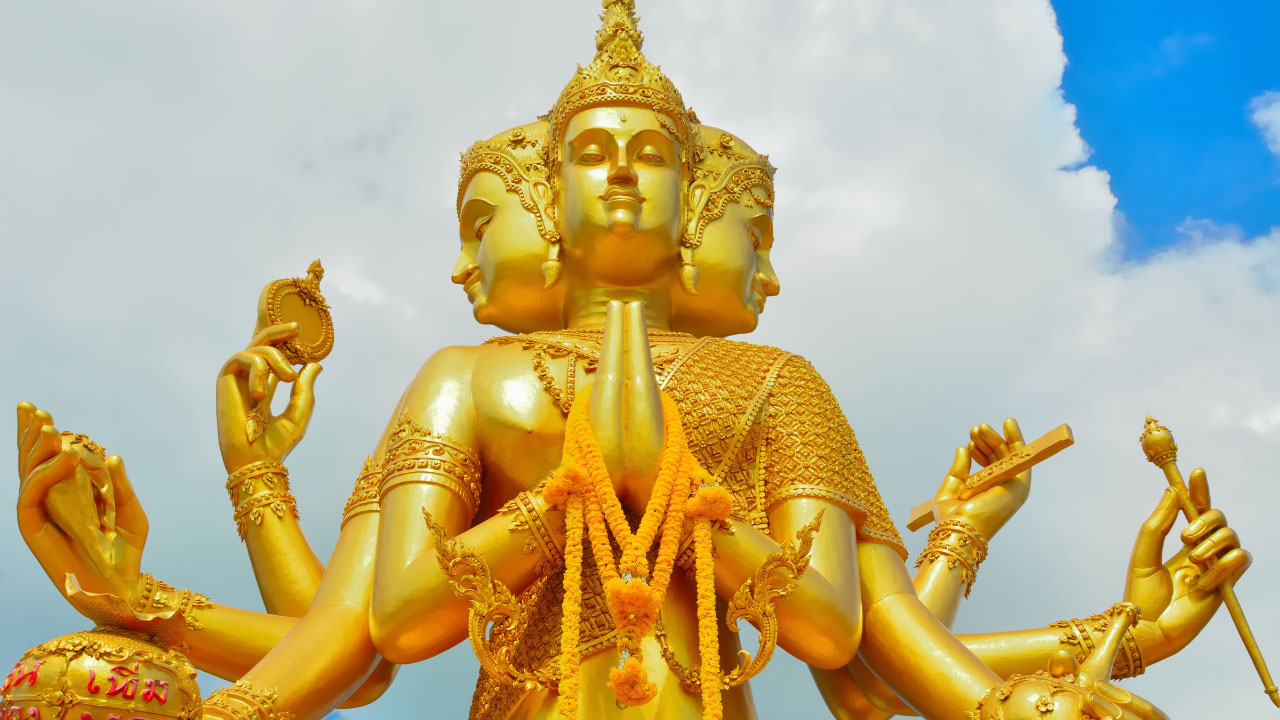
In the Puranic texts, or the Puranas, Saraswati is said to be born from Brahma’s own body, either from his mouth or his mind, depending on the version. As Vak (speech), she gives form to thought. As Saraswati, she bestows meaning upon matter. Without her, Brahma’s creation would remain inert, existing but incomprehensible. She brings buddhi (intellect), sankalpa (will), and chitta (consciousness) into the picture.
In many Puranic myths, Brahma becomes enamored with Saraswati’s beauty and intelligence. She tries to move away from him, but he sprouts additional heads to keep watching her, from the north, south, east, west, and finally above. This image, Brahma with five heads reflects the pursuit of knowledge can be corrupted by ego or unchecked desire.
Saraswati is sometimes portrayed as Brahma’s daughter, sometimes his consort, sometimes both, depending on the region and text.
In some tellings, Shiva, disturbed by Brahma’s obsession, cuts off his fifth head to restore balance. In others, Saraswati herself vanishes, distancing herself from Brahma’s grasp.
Saraswati as a Pan-Indian Deity
Saraswati is present wherever knowledge is honored, wherever music is created with intention, and wherever creativity is treated as a sacred act. She is the deity of those who learn and who refine.
In Tamil Nadu, Saraswati is deeply integrated into the rhythm of education. During Navaratri, on the final day known as Vijayadasami, children begin their formal education with a ritual called Vidyarambham, where they trace their first letters under her gaze. Books are laid at her feet as offerings.
In West Bengal, during Saraswati Puja, students clean their desks, decorate their instruments, and invite the goddess into their everyday tools of learning. She’s worshipped by treating the act of learning as a living ritual.
In Uttar Pradesh and northern India, Vasant Panchami marks her arrival at the cusp of spring. Students wear yellow, the color of blooming mustard fields and awakening intellect. Homes, schools, and even government institutions come alive with prayer and poetry, as people seek clarity of purpose.
In Vajrayana Buddhism, she transforms into Yangchenma, the goddess of eloquence, revered by Tibetan monks who chant her name before composing or teaching. In Jain traditions, Saraswati embodies Siddhayika, the perfect one, guiding seekers toward liberation through learning and introspection.
The Iconography and Symbolism of Saraswati
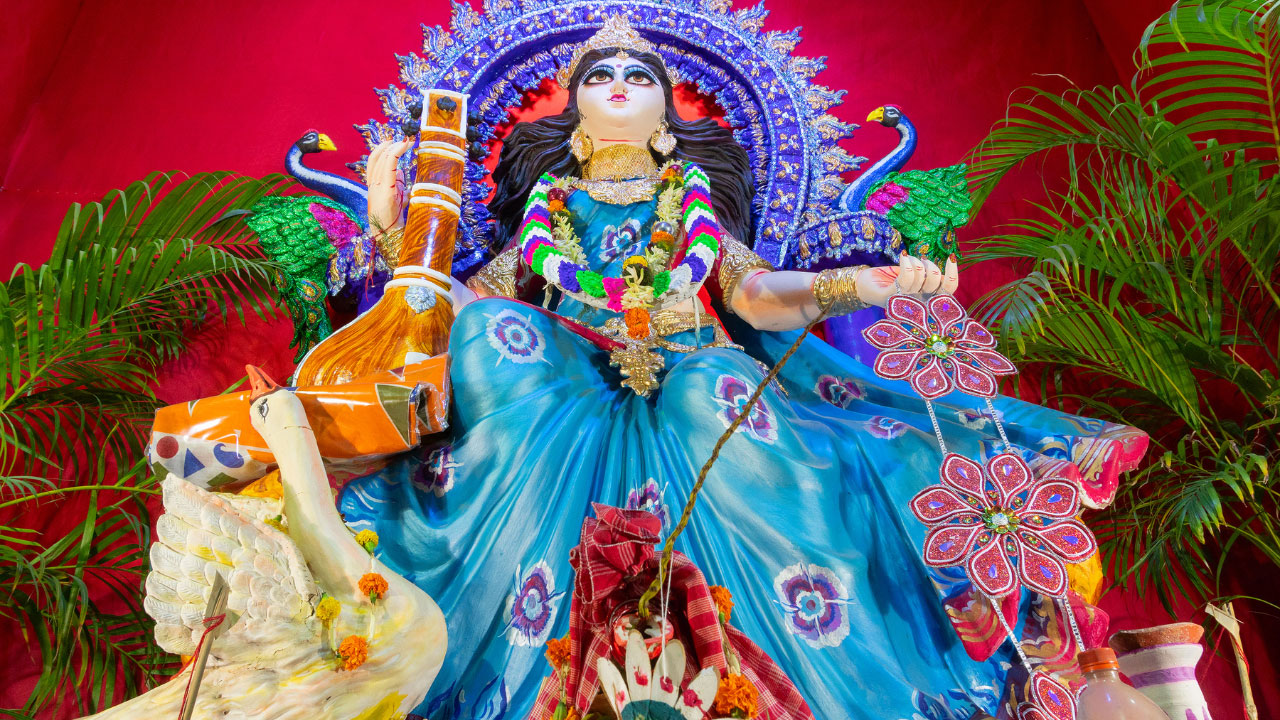
Saraswati’s white sari represents mental clarity, disciplined thought, and the kind of focus required to cut through confusion. White, in this context, signals neutrality and precision, a mind uncluttered by impulse or ego. She wears white because true knowledge requires purity of thought.
The lotus she sits on stands for resilience. The lotus blooms in murky water but rises clean, untouched by the mud below. Saraswati seated on a lotus reminds us that wisdom isn’t reserved for those sheltered from life’s messiness. It belongs to those who grow through it, learn from it, and still stay centered.
The swan beside her represents viveka, the power of discernment in Hindu philosophy. It’s said that a swan can separate milk from water, symbolizing the ability to separate truth from illusion, wisdom from noise. Saraswati doesn’t just bring knowledge. She brings the intelligence to sift through information and choose what actually matters.
The peacock often seen near her is striking and flamboyant, a living metaphor for vanity, ego, and showmanship. Saraswati doesn’t sit on it. She stays beside it, grounded and composed. That detail matters. It shows she sees distraction for what it is and doesn’t let it define her. Her wisdom isn’t about applause. It’s about alignment with truth, whether or not anyone’s watching.
The Meaning Behind Her Four Arms and Objects
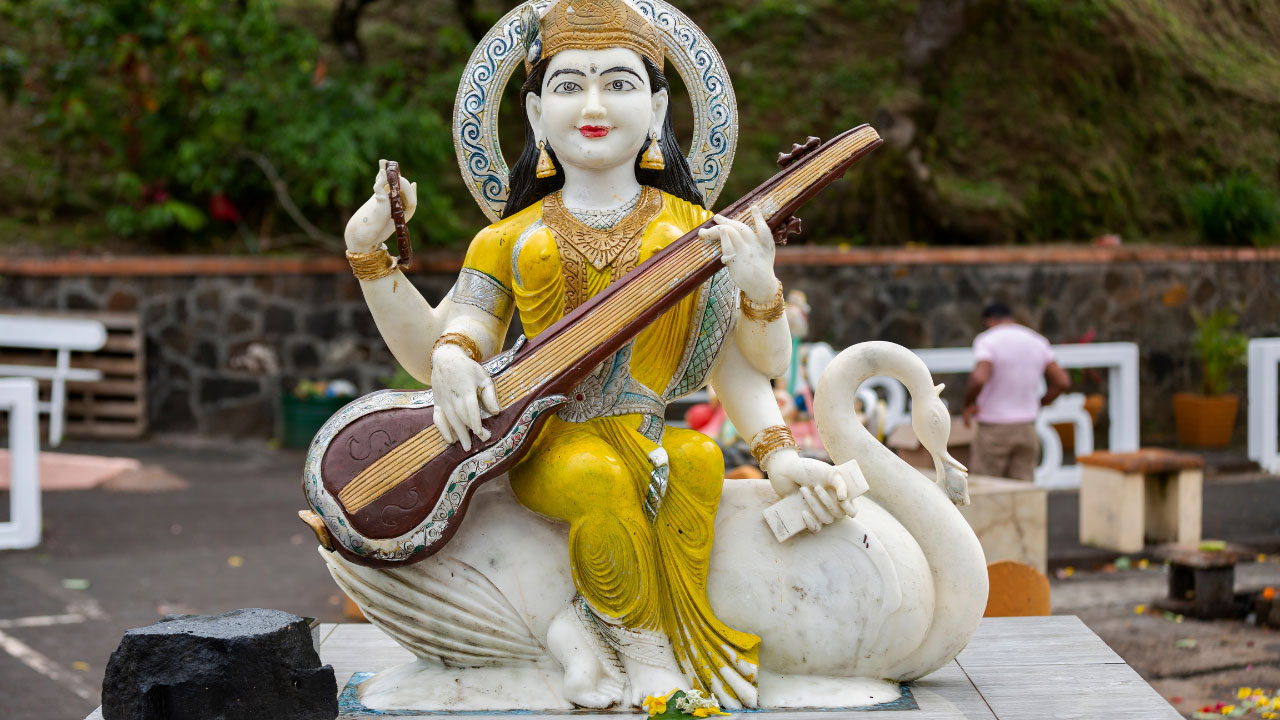
Veena – The Sound of Mastery
In Indian classical tradition, the Veena is one of the most complex string instruments to learn, requiring acute sensitivity, subtle movement, and years of focused training. In Saraswati’s hands, the veena is a symbol of svara (tone), tala (rhythm), and rasa (emotion), the elements that transform raw sound into refined art.
Its presence in Saraswati’s lap tells us that knowledge is not just logical but also rhythmic, musical and embodied. The veena responds to calibration. If your touch is too light, the note falters. If it’s too heavy, it distorts. Saraswati’s veena demands balance, a precision that mirrors the process of learning itself, subtle, layered, cumulative.
This image reminds us that true mastery is not frantic. It is steady, alert, and rooted in repetition. In the mythology of classical Indian music, the veena is often associated with the voice of the divine. Nada Brahma, “the universe is sound”, is a central Vedic concept. Saraswati’s veena holds the principle of shabda (sacred sound), showing that knowledge vibrates, resonates, shapes experience. Just as a poorly tuned veena cannot produce beauty, an unexamined mind cannot produce wisdom.
Palm Leaf Manuscript – The Written Power of Thought
In Saraswati’s lower left hand, she holds a tāla-patra grantha, a palm leaf manuscript. This is a stack of treated and inscribed palm leaves, tied together with string, historically used in India for recording sacred texts, philosophy, mathematics, astronomy, music theory, medicine, and law. For over 2,000 years, palm leaf manuscripts were the primary vehicle for preserving human knowledge across the Indian subcontinent.
The presence of this object in Saraswati’s hand signals that thinking is not enough. To be of value, thought must be disciplined, tested, refined, and critically preserved.
This manuscript demands the humility to write your ideas down and the courage to let them be seen, examined, and possibly challenged. It also reminds you that intellectual work is not just for your own insight, it is meant to be transmitted. Through writing, Saraswati upholds parampara, the uninterrupted lineage of knowledge passed from teacher to student, generation to generation.
The manuscript represents the transition from subjective experience to objective knowledge. A thought in the mind can remain vague, contradictory, or emotionally distorted. But when you attempt to write it, you are forced into precision. Saraswati, as the guardian of Vak (speech), insists on this. The written word becomes a test, can your knowledge withstand the sharp edge of articulation?
Water Pot (Kamandalu) – Purity of Thought
In her upper left hand, Saraswati holds a kamandalu, a traditional water vessel made from either metal, clay, or dried gourd. In Hindu tradition, this pot is a sacred tool used by ascetics, sages, and sannyasis (renunciants) to carry water for purification rituals, drinking, and symbolic cleansing. It represents a life stripped of excess, a life focused on internal clarity rather than external accumulation.
In Saraswati’s context, the kamandalu does not symbolize renunciation of the world, but refinement within it. The water it holds is not for washing the body, similar to the sacred river Saraswati. It’s for purifying the mind.
Symbolically, water is linked to chitta, the field of consciousness in yogic psychology. For thought to be truly perceptive, the chitta must be still. Just like a still pond reflects the sky with precision, a settled mind reflects truth with accuracy. If the water is stirred, by distraction, stimulation, unchecked emotion, the reflection becomes distorted.
Varada Mudra – The Gift of Discernment
Saraswati’s fourth hand is open and extended downward in Varada Mudra, the gesture of bestowing blessings, offerings, and boons, as the patron goddess of knowledge and wisdom. Unlike Lakshmi, who offers prosperity, or Durga, who grants strength, Saraswati deals in jnana, wisdom, discernment, understanding. She does not reward devotion alone. She rewards discipline, study, and deep inquiry. The willingness to stay with a question long after it stops being easy to hold.
Saraswati withholds knowledge to protect it. Because true insight is powerful and misused by the undisciplined. Her blessing is available, but not automatic. You must become someone who is capable of receiving it responsibly.
And even then, Saraswati rarely gives answers. What she offers is the capacity to see more clearly, ask better questions, and refine your perceptions.
White Attire & White Lotus – Purity in Thought and Action
Saraswati’s white sari is a direct expression of sattva guna, one of the three fundamental qualities of existence described in Samkhya philosophy and heavily emphasized in the Bhagavad Gita, the Upanishads, and Ayurvedic texts. The three gunas, sattva (clarity), rajas (activity), and tamas (inertia), are the energies behind all human behavior and cognition. Sattva is the only one associated with truth, insight, and liberation (moksha).
By clothing Saraswati in white, unadorned, simple, and clean, iconographers are signaling mental lucidity, sensory restraint, and precision of thought. The white sari tells the viewer that Saraswati doesn’t entertain emotional chaos, intellectual arrogance, or theatricality. She exists in a mental state suited for deep, focused learning and subtle perception.
To learn what she teaches (whether grammar, poetry, astronomy, music, or logic), you must bring a sattvic mind: alert, calm, non-reactive, and able to perceive without distortion.
Her seat, the white lotus flower (shveta padma), reinforces this. In Indian botany, the lotus (Nelumbo nucifera) grows in marshes and stagnant water but always blooms above the surface, unstained by the mud beneath it. This motif appears in the Bhagavad Gita (5.10): “Just as the lotus remains untouched by water, so too should one remain unattached amidst action.”
Swan (Hamsa) - Discernment Over Distraction
The hamsa, or swan, in Saraswati’s iconography, often shown riding a swan, is directly tied to one of the core concepts in Vedanta, viveka, or discernment between the real (sat) and the unreal (asat).
In Advaita Vedanta, viveka is the first requirement for any seeker attempting to attain self-realization. The Vivekachudamani (Crest Jewel of Discrimination), attributed to Adi Shankaracharya, opens with this instruction:
“Jantunam narajanma durlabham - Of all births, the human birth is rare. But even rarer is discernment.”
The swan, in yogic mythology, is said to have the ability to drink a mixture of milk and water and extract only the milk, leaving the water behind. Obviously, this is physiologically impossible, but it’s a metaphor for how a trained mind should operate, sift signal from noise, essence from distraction, and permanence from impermanence.
Peacock – Rising Above Ego and Illusion
In Saraswati’s iconography, the peacock (mayura) often appears in the background. In classical Indian art and philosophy, the peacock carries a loaded symbolic meaning, ego, pride, illusion (maya), and aesthetic seduction.
In Hindu mythology, the peacock has long been associated with grandeur, display, and superficial beauty. Its feathers symbolize the seductive power of form: how things look, how they appear, how they perform. This is why the peacock is often tied to maya, the Sanskrit term for illusion or the veiling power of the world, which keeps the soul distracted from higher truth.
While Saraswati sits serenely on a white lotus and rides the swan (hamsa), a bird symbolic of discernment, she keeps the peacock close but not beneath her. The message is precise, you do not kill the ego, but you do not ride it. The peacock represents the desire to appear wise rather than be wise and the desire to signal knowledge rather than engage deeply with it.
Saraswati’s rejection of the peacock as her vehicle is a visual critique of this tendency. She teaches that true knowledge is not flamboyant. It does not need to be seen to be valid. It does not require applause, aesthetics, or spiritual branding.
Saraswati Puja: Worship and Rituals
Saraswati is invoked for access to refined perception. She responds to effort, intellectual integrity, and mental restraint.
In the Rigveda (Book 6, Hymn 61), Saraswati is praised as "the flow of inspiration and truth," and in the Yajurveda, she is linked with vak (speech) and medha (intelligence). Her mantras are often recited before study sessions, examinations, performances, or any act requiring focused mastery.
Worship begins with dhyana (contemplation) and avahana (invocation), followed by the offering of white flowers, fruits, sandalwood paste, rice grains, and sometimes a mirror, to symbolize inner reflection. Her altar includes:
- Books and manuscripts – representing preserved knowledge
- Musical instruments (veena, tanpura) – representing creative discipline
- Writing tools (pens, chalk, slates) – representing intentional expression
- The color white or yellow – representing sattva (mental clarity)
The Festival of Vasant Panchami
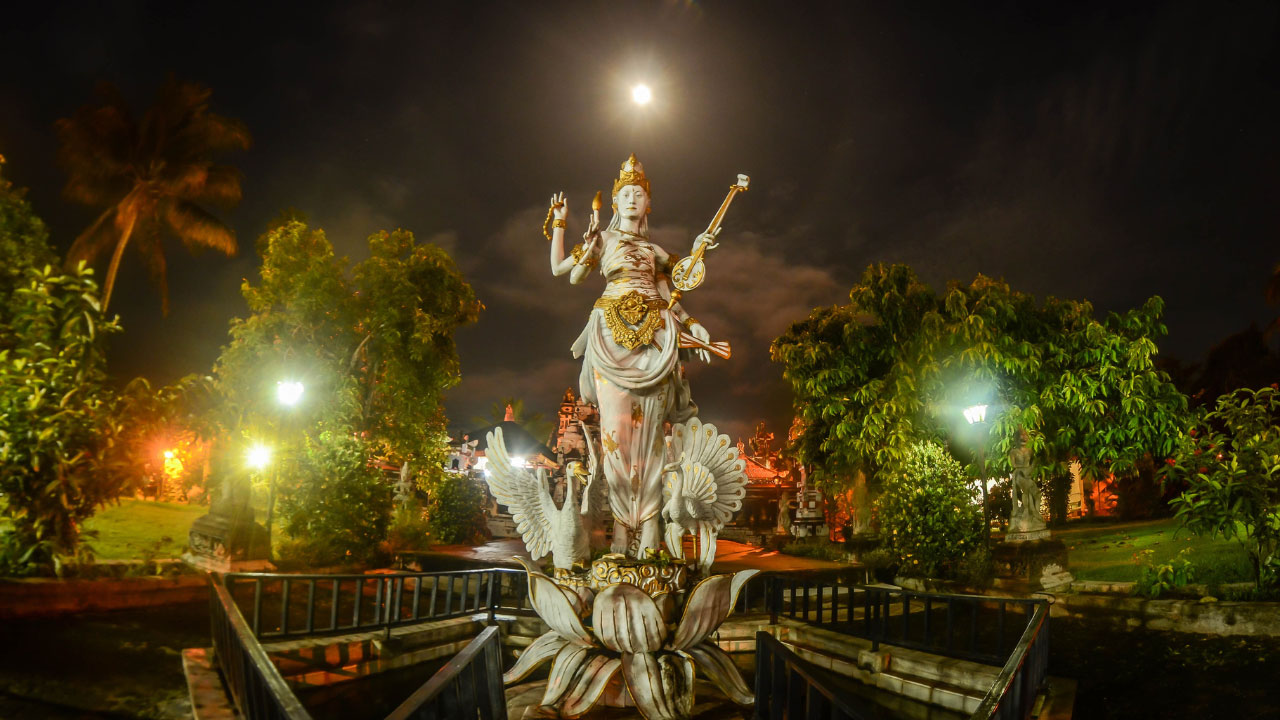
Vasant Panchami, also known as Saraswati Jayanti, falls on the fifth day (Panchami) of the bright half of the month of Magha (January–February), and is observed as the goddess’s birthday, a celebration of her emergence as an active principle in the intellectual life of civilization. This Hindu festival is celebrated with great enthusiasm across India.
This is the formal ritual start of learning (Vidya Arambham) in many parts of India. Children begin writing their first letters; artists initiate new creative works; teachers recommit to their craft. The festival reinforces a central principle in Indian epistemology: all knowledge, secular or sacred, must begin with Saraswati.
Regional Traditions and Symbolic Practices:
- West Bengal: Saraswati Puja is celebrated with deep cultural significance. Yellow (basanti) clothing is worn to reflect her association with the mustard fields in bloom and with illumination (jyoti). Students clean their desks, gather in front of idols or framed images, and lay out their books and instruments in front of her. On this day, these items are not touched, a symbolic pause that recognizes knowledge as something to be honored, not exploited.
- Tamil Nadu and Kerala: Saraswati is worshipped during the Navaratri festival as well, but on Vasant Panchami, quiet rituals are performed at home. Children write their first syllables of the alphabet (aksharabhyasam) in rice or sand. Offerings of white rice, banana, coconut, and jaggery are made, and learning is seen as an extension of sacred action.
- Punjab and North India: While Saraswati Puja is observed, it is often accompanied by kite flying, especially in cities like Amritsar and Patiala. The flying kites symbolize heightened perception and the ability to navigate unseen forces (wind).
- Andhra Pradesh & Karnataka: Vasant Panchami is treated as a preparatory phase for Shri Panchami, where Saraswati is worshipped as a Mahavidya, one of the ten great wisdom goddesses in Tantric traditions. Here, she is invoked for spiritual knowledge, particularly the knowledge that leads to moksha (liberation).
- Nepal & Indonesia (Bali): Saraswati Day (Hari Saraswati) is observed on the Balinese calendar (210-day cycle) and emphasizes the sanctity of books and written language. Books are decorated, worshipped, and not read on this day. Students wash their hands before touching texts, and women dress in white to signify alignment with sattva guna.
Saraswati in Hindu Philosophy and Mythology
In the Vedic tradition, Vak (वाक्), the Sanskrit term for speech is considered a primordial force. It is that which brings thought into form, bridging the unseen and the manifest. Saraswati, as Vak Devi, is the cosmic principle of structured sound, the intelligence that governs articulation, clarity, grammatical order, and linguistic integrity, as a significant Hindu deity.
In the Rigveda (10.125), Vak speaks in the first person as a deity, declaring:
“I am the queen, the gatherer-up of treasures, most thoughtful, first of those who merit worship. Thus the gods have established me in many places with many homes to enter and abide in.”
This hymn, often attributed to Vak Ambhrini, is one of the rare instances of female voice asserting divine agency in early Hindu scripture. Vak is not subservient, she creates, sustains, and directs all sacred acts. Saraswati inherits this role in later texts, becoming the personification of Vak as divine speech with intentionality.
Four Levels of Vak (Speech) in Hindu Thought
The Taittiriya Upanishad, as elaborated upon by grammarian philosophers like Bhartrihari and theologians like Abhinavagupta, describes vak as having four distinct levels:
- Para Vak – Transcendental speech; undifferentiated and beyond mental grasp. Exists in Brahman, the unmanifest.
- Pashyanti – Speech at the level of intuitive vision or insight. It is pre-verbal, but beginning to differentiate.
- Madhyama – Mental speech; the thought-form of language before it becomes vocalized.
- Vaikhari – Spoken, audible speech; what the world hears.
Saraswati presides over all four levels, but she is most withdrawn in Para, and most accessible in Vaikhari. When someone speaks truth that is both intellectually accurate and spiritually aligned, they are said to be invoking Saraswati in full.
Vak as a Creative and Moral Force
Hindu philosophy treats speech as karmically consequential. Words have ontological weight. To speak is to shape reality. Every mantra, sutra, and shloka is an act of creation (srsti). This is why Saraswati is invoked before beginning any Vedic recitation, scriptural study, or philosophical debate as a protective invocation against distortion.
To misuse speech, to lie, flatter, gossip, argue from ego, is to desecrate Vak and invite her withdrawal. In texts like the Mahabharata, speech that lacks dharma (moral integrity) is called asatya vak, untruthful speech, which generates negative karma regardless of its outcome.
In Tantra and Later Philosophical Systems
In Tantric traditions, particularly in the Shakta schools, Saraswati is part of the Mahavidya system, the ten great wisdom goddesses. Here, she is associated with Matangi, the outcaste goddess who governs impure speech, inversion, and the breaking of linguistic taboos. The Saraswati-Matangi duality reflects a key Tantric principle, that clarity and chaos are both aspects of language, and that to fully master speech, one must understand both its order and its shadows.
In Kashmir Shaivism, especially under the works of Abhinavagupta and Kshemaraja, Vak becomes a central force in Spanda theory, the theory of divine vibration. In this view, the universe itself is a vibration (nada) emanating from Shiva’s will (iccha), shaped into form through Vak.
Evoking Saraswati
You call upon Saraswati when your mind needs clarity, when your creativity needs direction, and when your voice needs truth.
The best times are:
- Before studying, writing, or diving into deep work, because Saraswati is the current of focus and understanding.
- Before playing music, painting, or creating art, because she governs not just skill, but the connection between inspiration and execution.
- During Saraswati Puja, Vasant Panchami, and sacred recitations, when her energy is most accessible and powerful.
Living in Alignment with Saraswati’s Teachings
- Pursue Knowledge with Humility and Openness: True wisdom isn’t about having all the answers but never stopping the search. Saraswati thrives where curiosity lives. Worship Saraswati by pursuing knowledge with humility and openness. Read widely, ask better questions and be willing to be wrong.
- Speak with Clarity, Truth, and Sincerity: Words shape reality. Saraswati governs speech, but she doesn’t bless empty noise. She stands with those who speak truth, who choose clarity over convenience, who understand that words carry weight. Before you speak, ask: Does this bring wisdom, or just sound?
- Nurture Creativity and Intellectual Curiosity: Saraswati fuels innovation, not just in art and music, but in thought, in discovery, in the boldness to create something new. Creativity isn’t about waiting for inspiration to hit, but about discipline, practice, and the willingness to refine your craft. This is important because Saraswati doesn’t bless passive dreamers, but those who put in the work.
- Practice Discernment (Viveka) to Separate Illusion from Truth: Not everything dressed as knowledge is wisdom. Saraswati is the sharp blade that cuts through illusion, the voice that says, Look deeper, think critically, and question everything. Aligning with her means having the courage to challenge falsehoods, within yourself and the world around you.
Chanting Saraswati Mantras
Uttering a mantra produces an effect. Saraswati mantras used to sharpen the intellect, purify speech, enhance memory, and prepare the mind for disciplined inquiry.
As Vak Devi, Saraswati governs shabda brahman, the idea that reality is structured through sound. To chant her mantras is to engage directly with the vibrational architecture of knowledge.
Chanting is most effective when done daily, particularly at sunrise (Brahma Muhurta) or just before intellectual work begins.
Core Saraswati Mantras
- Bīja Mantra (Seed Sound):
ॐ ऐं नमः
Om Aim Namaha- "Aim" (ऐं) is the bīja (seed syllable) of Saraswati
- Pronounced: “I’m” with a nasal resonance
- Purpose: Activates the throat chakra (Vishuddha) and governs clarity of thought and speech
- Use: Repeat 108 times using a white crystal or rudraksha mala. Use before public speaking, writing, or study.
-
Saraswati Dhyan Mantra (For Invocation and Focus):
या कुन्देन्दु तुषार हार धवला या शुभ्रवस्त्रावृता।
या वीणावरदण्डमण्डितकरा या श्वेतपद्मासना॥
या ब्रह्माच्युतशंकरप्रभृतिभिर्देवैः सदा वन्दिता।
सा मां पातु सरस्वती भगवती निःशेषजाड्यापहा॥
Ya kundendu tusharahara dhavala ya shubhravastravrta
Ya veenavara dandamanditakara ya shvetapadmasana
Ya brahmachyuta shankara prabhritibhir devaih sada vandita
Sa mam patu Saraswati bhagavati nishshesha jadyapaha
- Translation: “May Goddess Saraswati, who is pure as the jasmine, white as the moon, and dressed in radiant white garments, seated on a white lotus, and venerated by Brahma, Vishnu, and Shiva, protect me and remove my inner lethargy.”
- Use: This mantra is ideal before beginning a new area of study or when feeling stuck mentally. Recite with full attention, slowly, audibly, and seated upright.
-
Saraswati Vandana (Learning Invocation Mantra):
सरस्वति नमस्तुभ्यं वरदे कामरूपिणि।
विद्यारम्भं करिष्यामि सिद्धिर्भवतु मे सदा॥
Saraswati namastubhyam varade kamarupini
Vidyarambham karishyami siddhir bhavatu me sada
- Translation: “Salutations to you, O Saraswati, who grants boons and fulfills desires. I begin my studies—may I always be successful.”
- Use: Traditionally chanted by young students before their first lesson (Aksharabhyasa) and by adults before any intellectual or creative endeavor.
How to Chant Saraswati Mantras Correctly
- Time: Best during Brahma Muhurta (roughly 4–6 a.m.), or before any concentrated task
- Posture: Sit facing east or northeast, spine erect, eyes gently closed
- Breath: Regulate your breath before starting, chant on the exhale for resonance
- Number: Use a 108-bead japa mala; minimum 27 repetitions for short sessions
- Focus: Visualize white light entering the crown of the head and gathering at the throat, aligning thought and speech
- Mental State: Don’t chant distractedly or casually. Saraswati mantras are tools for sharpening perception, and must be treated like training, not prayer
Conclusion
Saraswati represents a standard you hold yourself to. She asks you to think more clearly and create with intention. She is the discipline behind every skill and the stillness behind every breakthrough.
What she offers is the capacity to keep asking better questions. Saraswati shows up when you’ve prepared. She responds to those who are willing to let the unnecessary fall away.
To walk with Saraswati is to live in clarity.
To speak with Saraswati is to speak only what’s worth saying.